.png)
India is a major obstacle to Sheikh Hasina’s execution
Published: 06:28 PM, 24 November 2025
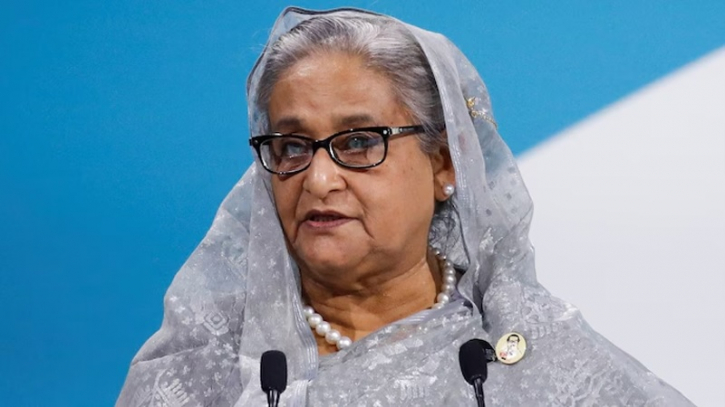
She was once a symbol of secularism—the daughter of a revolutionary leader. Her father’s brutal assassination in the 1970s defined her political rise. But Sheikh Hasina’s rise to power has ultimately turned into a dramatic downfall, leading to her forced exile in India.
Sheikh Hasina’s death sentence, pronounced in absentia, would put her on the brink of execution—if New Delhi decides to deport her.
The ousted leader was convicted of crimes against humanity in 2024 for atrocities during a student uprising. After 15 years of increasingly authoritarian rule, she fled to India last August and sought refuge in the capital of a country that was once her closest ally.
Now she has become the focus of strained relations between the two countries—with Dhaka demanding her return to the country to face justice, even as Sheikh Hasina claims the charges are politically motivated. He did not commit this crime.
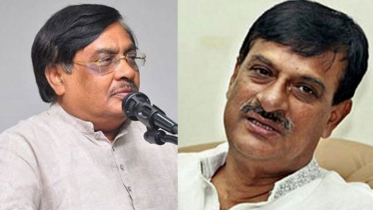
Bangladeshi political scientist Mobaswar Hasan said, “He had to flee to escape the wrath of the people. He is hiding in India and the death sentence was pronounced there—it is an unbelievable story.”
A bloody past
Sheikh Hasina's political journey is like a Shakespearean tale—a long tale of tragedy, exile and power, inextricably linked to her country's history.
Sheikh Hasina, the eldest daughter of Bangladesh's charismatic 'Father of the Nation' Sheikh Mujibur Rahman, has been immersed in politics since childhood. But it was one bloody night in August 1975 that changed her life the most.
That day, members of the army killed her father, mother and three brothers. Sheikh Hasina and her sister were in West Germany at the time and survived.
During this time of anarchy, Ziaur Rahman came to power. He was the husband of Sheikh Hasina's future main rival, Khaleda Zia. Ziaur Rahman's government passed a law that protected Sheikh Mujibur Rahman's killers for decades.
Sheikh Hasina's life changed that night and she was forced to spend six years in exile in India. The time instilled in the future leader a deep respect for the Indian state.
When she returned home in 1981, there was a nationwide expectation of secularism. But she too entered a political arena that was to be defined by another woman who fell into tragedy—Khaleda Zia, whose husband was also later assassinated.
Recalling the day she returned from exile, Hasina said, “I did not find any relatives at the airport, but I found the love of millions of people—that was my strength.”
Thus began the era of the ‘hateful begums’—a deeply personal yet devastating conflict between two women whose effects would haunt Bangladesh for the next 30 years.
‘She had to flee’
Hasina began a long political journey, taking the reins of her father’s party, the Awami League. She faced house arrest and repression amid growing conflict with Khaleda Zia. Sheikh Hasina became prime minister for the first time in 1996 after a long struggle under the leadership of the Awami League.
Read more: Ai Khan Panna to run for Sheikh Hasina
Her first announcement after taking office was to start the trial of the 1975 massacre.
Although Hasina, a follower of secular ideology, lost power after one term, she returned in 2008 with a tougher, more assertive stance.
For the next 15 years, she ruled Bangladesh with increasing rigor and ushered in an era of strong economic growth. At the same time, she provided significant support to India, strengthening New Delhi’s hand through economic and security agreements. , which has drawn hostility from Pakistan and China.
But Bangladesh’s development success has come at a high price. Human rights groups have warned that she and her government are moving towards a one-party system. Critics say the country is moving towards a one-party system.
As pressure mounts, Sheikh Hasina “could count on India for unquestioning support,” the Indian newspaper The Indian Express recently commented in an editorial.
But her image at home has been tarnished by an aggressive crackdown. “She has shed a lot of blood to stay in power,” says political scientist Mobashwar Hasan.
She has seemingly maintained her grip on power. She has proven adept at handling popular protests, arrests and assassination attempts. But last year’s youth-led uprising was different.
Demands for quota reforms in government jobs The student protests that began with the assassination of Prime Minister Sheikh Hasina quickly turned into a nationwide mass movement demanding her resignation. According to the UN Human Rights Office, the government resorted to a brutal crackdown to control the situation, killing around 1,400 people.
Yet the movement did not stop—in fact, it exploded even more. It turned the public’s anger into an irresistible force that ultimately toppled her government.
Political scientist Mobashwar Hasan said, “She had to flee. This in itself is an admission of guilt. The people, various forces—everyone turned against her. Because she had crossed the line. She killed, so many people were killed on her orders.”
Death sentence
Sheikh Hasina’s current life, while in political asylum in India, seems to be taking her back.
.png "Advertisement")