.png)
Tensions over Sheikh Hasina’s death sentence: Bangladesh-India relations under severe test
Published: 06:04 PM, 20 November 2025
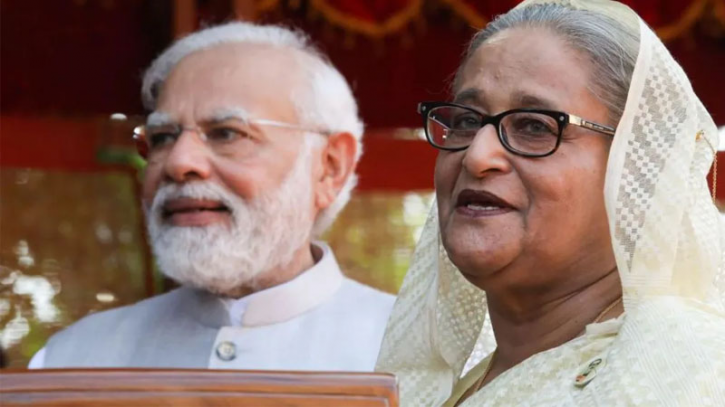
The death sentence of ousted Prime Minister Sheikh Hasina for crimes against humanity has put Bangladesh-India relations under a severe test. At the same time, her stay in India has also created new tensions between the two countries.
On the one hand, Dhaka wants her back, on the other hand, Delhi's denial is further complicating the situation. This information was reported by the British media outlet BBC in a report on Thursday (November 20).
The media outlet says that India's long-standing closeness with the former Bangladeshi prime minister was both strategically valuable and politically risky. During her 15 years in power, she ensured the things India loved the most. And that is - stability and increased connectivity in the region. Besides, under Hasina, Bangladesh was a neighbor who always aligned its interests with India, not with China.
After being ousted from power in the student-public movement, Sheikh Hasina is now staying in New Delhi. But in the meantime, the International Crimes Tribunal in Bangladesh sentenced her to death for crimes against humanity on charges of suppressing the student movement.
She was forced to leave the country after the 2024 movement. And through that movement, an interim government led by Nobel laureate Dr. Muhammad Yunus came to power. Elections are scheduled to be held in Bangladesh early next year.
This entire sequence of events has created a complex diplomatic problem. And that is - Dhaka wants Hasina to be sent back, but Delhi is not showing any interest in it. As a result, there is no way to actually implement her death sentence.
The asylum that Delhi wanted to provide as humanitarian aid has now become a long and uncomfortable test for India. India is also trying to understand how far it can go for an old ally and how much diplomatic price it is willing to pay for it.
South Asia analyst Michael Kugelman said that India has four uncomfortable paths ahead of it. One - Send Hasina back, but India will not want to do that at all. Two- Maintaining the status quo, but it will become even more risky when a new government comes to power. Three- Pressuring Hasina to remain completely silent, not to give any statements or interviews. But she is still leading the Awami League, so it is difficult for Hasina to accept this. Moreover, it is problematic for Delhi to impose something like this. Four- Trying to send Hasina to a third country, although very few countries would want to take in such a ‘high-risk guest’. Because Hasina has serious legal charges against her and she needs a huge security arrangement.
According to Kugelman, extraditing Hasina to Bangladesh is unthinkable for India, because everyone from the ruling party to the opposition political camp in the country, sees her as a close friend of India. And “India never puts its friend in danger” – this is India’s long-standing policy.
And this current moment is even more uncomfortable for Delhi because the roots of India-Bangladesh relations are very deep. India’s role was also important during Bangladesh’s independence.
Bangladesh is India’s largest trading partner in South Asia. And India is now Bangladesh's largest export market in Asia. Last year, the trade between the two countries was about $13 billion. Both countries have a large trade deficit and Bangladesh is heavily dependent on India for raw materials, energy and transit facilities.
In the last decade, India has given Bangladesh a low-interest loan of $8 to $10 billion. At the same time, it has provided duty-free facilities for some products, built rail links, and supplied electricity and fuel. And so there is no opportunity for either side to easily withdraw from this relationship.
Jawaharlal Nehru University professor Sanjay Bhardwaj said that the mutual dependence of the two countries in various areas, including water and electricity, is so deep that it is difficult for Bangladesh to function normally without India's cooperation.
However, many believe that the interim government led by Dr. Yunus is rapidly reshaping Bangladesh's foreign policy. In a study published by the National University of Singapore, politician Bean Tsai said that the new government is on the path of "de-Indianization", that is, it wants to reduce dependence on India.
Now they are cancelling judicial exchange programmes, renegotiating energy deals with India, slowing down India-dependent connectivity projects and openly turning to China, Pakistan and even Turkey for strategic partnerships. And the message from here is clear. And that is that Bangladesh is no longer India’s most reliable neighbour.
The deterioration of this relationship is also reflected in public opinion polls. A recent survey by the Centre for Alternatives in Dhaka found that 75 per cent of Bangladeshis view relations with China as positive, but only 11 per cent view India. Many believe that the Hasina government has become increasingly authoritarian in the end due to India’s support. As a result, India now seems to many as a kind of domineering neighbour.
Professor Bhardwaj said that despite political upheavals, economic and cultural ties generally survive. Trade between the two countries also increased during the BNP-Jamaat government in 2001-2006.
The main challenge for Delhi now is not just to deal with a former ally in exile, but to maintain good relations with a neighbour that is crucial to India's security. Counter-terrorism operations, border management and connectivity to India's northeast are all Bengali.
.png "Advertisement")