.png)
60 years ago, the United States dropped four nuclear bombs on Spain!
Published: 06:55 PM, 15 July 2026
In the early 1960s, the United States launched a project called ‘Chrome Dome’ to prevent the Soviet Union from launching a preemptive strike. Under this, nuclear-armed B-52 bombers regularly patrolled the airspace, so that they could attack Moscow at any moment. However, to stay in the air during this long journey, the planes needed to refuel in mid-air.
On January 17, 1966, one such bomber was flying at 31,000 feet over the Almeria region in southern Spain. At that time, the plane was trying to collect fuel from a KC-135 tanker plane.
At that time, when the B-52 bomber collided with the fuel tanker, the jet fuel in the KC-135 exploded, killing all four crew members of the plane. Two more crew members in the tail section of the B-52 were killed in the explosion. A third man used a parachute but it failed to open, and he also died. The remaining four members of the bomber were able to safely eject before the plane broke up.
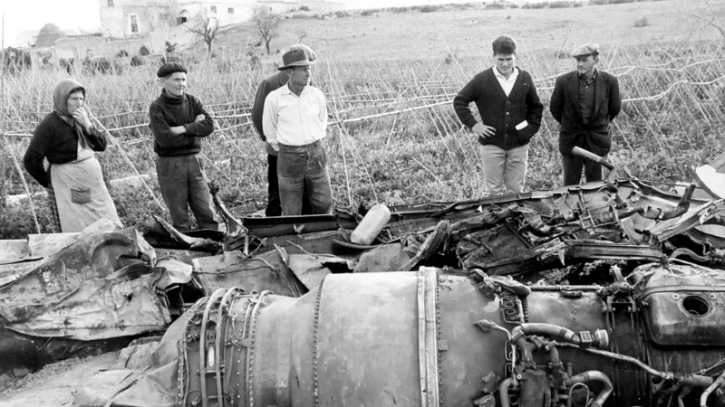
The burning wreckage of the plane and four deadly thermonuclear bombs then rained down on the remote Spanish village of Palmares. The huge fireball was visible from a mile away. Fortunately, no nuclear explosion occurred. The bomber's warheads were not active at the time. They were equipped with safety features to prevent an unintended nuclear chain reaction.
But the thermonuclear devices contained explosives around a plutonium core as part of the trigger mechanism. In the event of an accident, the bombs were supposed to have parachutes attached to them, to reduce the impact and prevent the spread of radiation. In fact, one unexploded bomb landed safely on the riverbank and was recovered intact the next day. Unfortunately, the parachutes of the other two nuclear bombs did not open.
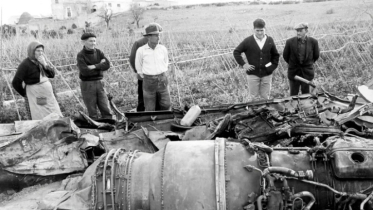
The other hydrogen bomb also exploded on the ground near the cemetery. These two explosions created huge craters. They spread highly toxic radioactive plutonium dust over hundreds of acres of land. Burning wreckage of the plane also spread throughout the village.
As soon as the news reached the US military command that the bomber had crashed with a nuclear weapon, a huge rescue operation began. Captain Joe Ramirez was a US Air Force lawyer stationed in Madrid at the time of the crash. In 2011, he told the BBC's 'Witness History' programme, 'Everyone in the conference room was very excited. Everyone was talking about Broken Arrow. That's when I knew that Broken Arrow was the code word for a nuclear accident.'
US troops were brought to the crash site by helicopter. The smoldering wreckage was scattered all over the area—a large part of the B-52 bomber had fallen in the village schoolyard.
Miraculously, no one from the village died in the crash. “About 100 tons of burning debris fell on the village,” said BBC journalist Chris Brasher, who went to investigate the crash a couple of years after the crash, “but not a single chicken died.”
The three B-52 crew members who parachuted into the Mediterranean Sea a few miles offshore were rescued by local fishermen within an hour of the crash. The fourth, the radar-navigator, was ejected during the explosion. He was severely burned and could not free himself from his ejection seat. He was able to deploy his parachute and was later found alive near the village.
However, the problem was still finding the remaining nuclear weapons on board. “My main objective was to recover the bombs, that was the main priority,” General Wilson told the BBC in 1968.
He added, “The first night the Guardia Civil (Spain’s national police force) came to the little bar in Palmares, the only one in the whole village with electricity. They reported a bomb, so we sent our men in immediately. The next morning we started searching as soon as the sun came up. We found two more bombs at around 10 or 11 a.m., if I remember correctly.”
Thus, three nuclear bombs were found, but one was still missing. The next day, US troops were brought in by truck from a nearby base. The beach at Palmares became a base for about 700 US airmen and scientists, who were desperate to control the radiation and find the fourth warhead.
But despite a week-long search by hundreds of US soldiers and scientists, the fourth bomb was never found. Captain Ramirez then spoke to a local fisherman. The fisherman repeatedly apologized to Captain Ramirez, saying that he had not been able to save an American soldier, whom he had seen sinking at sea.
Captain Ramirez realized that the fisherman might have seen the missing nuclear bomb. “Because I knew all the bodies had been recovered,” he said. The search then quickly turned to the Mediterranean. The US Navy sent a fleet of more than 30 ships, including minesweepers and submersibles, to clean the seabed. Searching miles and miles of the ocean floor was a technically complex and slow process. However, after weeks of tireless efforts, the new-technology submarine ‘Alvin’ finally located the missing bomb in a trench on the seabed. The warhead was safely recovered and handed over to US authorities about four months after its disappearance.
Almost six decades after the accident, the palm
.png "Advertisement")