HB Rita’s Living Document of the Indestructible July Revolution

Published: 12:49 AM, 4 June 2026
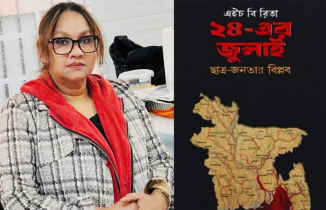
The student-public uprising that took place in Bangladesh in July-August 2024 is a groundbreaking chapter in contemporary history. This bloody diary and an unflinching documentary document of the infinite courage of the young generation have been written as a book by writer and journalist HB Rita, '24-er Juli Chhatra-Jantaar Biplab' (Ghasful Publishing, 2025).
The book is basically an objective account of the bloody history of 36 days from July 1 to August 5, 2024 and the fall of the long decade and a half of dictatorial rule. The book contains a thorough account of how the fall of the long decade and a half of dictatorial rule was confirmed through just 36 days of indestructible mass movement.
However, it is not just a diary of the movement, but an intensive sociological and psychological dissection of the overall political system of Bangladesh. Journalist and writer Kakan Reza, in his foreword, has described the book not just as a book, but as a 'disenchanted history of the July Revolution written in words'.
The book basically captures the bloody history of 36 days from July 1 to the fall and exile of Sheikh Hasina on August 5. It discusses in detail the birth of the second edition of 2024 in continuation of the 2018 quota movement, the students taking to the streets to break the 56% quota inequality, and the political turn of the peaceful movement under state incitement.
The author has very objectively highlighted how Abu Sayeed's heroic sacrifice on July 16 and subsequent government brutality like internet blackout and curfew incited the accumulated anger of the common people and transformed it into an all-out mass uprising. A large part of the book explores why the new generation had to call for revolution against the Awami League after 53 years of independence.
The author, while acknowledging Bangabandhu's leadership from a very neutral perspective, structurally analyzes the controversial decisions of the last part of his political life (such as the formation of the one-party 'Bakshal' in 1975) and the subsequent 15-year rule. Based on the sources of political researcher Badruddin Umar and Professor Dilara Chowdhury, she shows how the party gave birth to fascism by deviating from its original spirit.
The book gives special importance to the 'ruthless drama' of DB Hefazat. In contrast to the video message that the main coordinators, including Nahid Islam, Asif Mahmud and Sarjis Alam, were forcibly detained and withdrawn and broadcast, the author very bravely portrays the coordinators' hunger strike to death inside the DB office and their inflexible position in demanding the '9-point demand' after their release.
One of the strongest aspects of the book is that it tabulates a documentary geographical picture of the genocide taking place across the country based on reliable domestic and foreign information. The daily violence in the district, mass arrests, disappearances of coordinators, precise death tolls, names and identities of martyrs, and the tragic family situations of the deceased are brought up here in emotional language.
The issues of the constitutional vacuum created after August 5 and planned communal propaganda are also not left out. Being a professional teacher and a student of psychology, the author has very skillfully dissected the psychological basis of the mass uprising of 24. She has very skillfully dissected the psychological basis of the mass uprising of 24 based on Wilhelm Reich's famous 1933 book 'The Mass Psychology of Fascism'.
She has shown that the 'culture of oppression and fear' that autocratic rulers created in society, 'Generation Z' of the 24th century, standing up to receive the book, instantly shattered that psychological inertia. History is often distorted by the victors, but this book is not a political propaganda as it is written on the basis of reliable domestic and foreign sources, newspaper headlines and data.
The way the author, without being physically present on the battlefield, has compiled the account of every blood cell through technology and sensitive thinking while sitting in exile, will remain for future generations as the most reliable, irrefutable and referable documentary document in the history of the 24th revolution. HB Rita, a son of Narsingdi, who has been engaged in teaching and journalism in the United States for 27 years, has compiled this complex history through technology and sensitive thinking, even though she was not physically present on the battlefield, and has been awake day and night, which deserves praise.
This is not just a book, but a historical and documentary document of the people's resistance against discrimination and tyranny, which every conscious citizen should read.