.png)
Court again blocks Trump’s bid to end birthright citizenship
Published: 09:43 PM, 3 September 2026
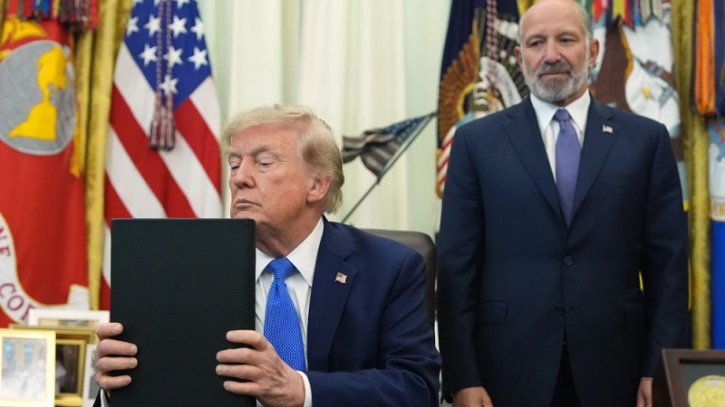
A federal court in Maryland has blocked President Donald Trump's latest attempt to limit birthright citizenship in the United States, a move that comes after the country's Supreme Court ruled a similar move unconstitutional.
On Wednesday (September 2), Maryland District Judge Deborah Boardman issued a preliminary injunction on Trump's new executive order issued on August 6.
Trump's new order aimed to curb so-called "birth tourism," the practice of foreign nationals seeking citizenship by giving birth in the United States. The order sought to prevent certain categories of foreign nationals from becoming U.S. citizens by birth.
This includes children of foreign nationals who are alleged to have engaged in commercial transactions for the purpose of obtaining citizenship or who have been classified as 'enemy aliens'.
But Judge Boardman said Trump's new order is likely to be unconstitutional, just like his previous initiatives, citing the Supreme Court's ruling in Barbara v. Trump last June.
In a written court order, Boardman said that the Supreme Court has already ruled in the "Barbara" case that children in the relevant class are US citizens at birth, so Trump's new initiative to take away their citizenship rights will not be constitutionally sustainable.
The judge said that for this reason, the implementation of the president's latest effort must also be initially halted.
Earlier, in the 'Barbara' case, the Supreme Court ruled 6-3 that birthright citizenship is protected by the 14th Amendment to the United States Constitution. Under this provision, most people born on U.S. soil automatically acquire U.S. citizenship. However, there are some limited exceptions, such as children of diplomats or members of an occupying force.
The constitutional basis of birthright citizenship has been upheld in various rulings of the US Supreme Court over the years. Notable among these is the case of 'US v. Ong Kim Arak', which recognized the citizenship rights of Ong Kim Arak, a Chinese-American citizen.
However, during his campaign for a second term as president, Trump promised to tighten immigration controls in the United States. One of his promises was to change the traditional system of birthright citizenship.
Trump and his allies claim that children of immigrants who are in the United States on temporary visas or illegally are not entitled to citizenship at birth. They argue that these immigrants are not under the "jurisdiction" of the United States.
Despite the Supreme Court defeat in June, the Trump administration and its allies have been finding ways to challenge constitutional protections for birthright citizenship.
Wednesday's lawsuit was filed by immigrant rights groups and several families, including the Asylum Seeker Advocacy Project.
Last year, the same judge, who had blocked the Trump administration's first executive order, ordered the plaintiffs to amend their complaint to include the new executive order separately.
It was then that the judge expressed doubts about the constitutional validity of Trump's latest initiative, calling it "unprecedented.In Wednesday's ruling, he reiterated that the Supreme Court's decision is clear - children from the relevant classes are 'citizens at birth'.
Source: Al Jazeera
.png "Advertisement")