.png)
Is Israel on the path to civil war?
Published: 02:50 PM, 28 August 2026
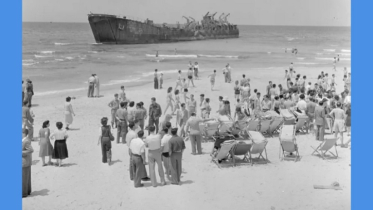
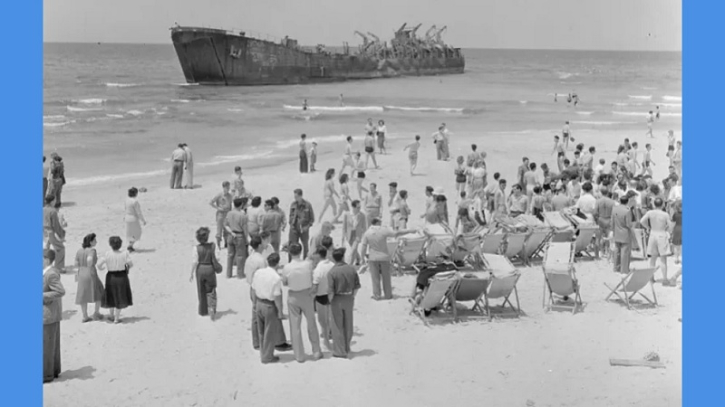
Israeli Prime Minister Benjamin Netanyahu stood in front of the Itzel Museum on the Tel Aviv waterfront on August 24 to announce the recovery of the wreck of the ship "Altalena." The ship, owned by the right-wing Jewish paramilitary organization Itzel, was damaged by shelling by the newly formed Israeli army in 1948.
Netanyahu promised that the ship would be raised from the bottom of the sea and turned into a symbol for future generations. The main message of that symbol would be: 'Never again civil war.'
The Itzel, known in English as the Irgun, was a highly nationalistic Jewish political organization. Before the establishment of Israel, the organization operated as an independent armed force. Even after the establishment of the new state, they were reluctant to hand over their weapons and autonomy to the new government.
The wreckage of the burnt ship 'Altalena' off the coast of Tel Aviv, Israel, 1948.
In June 1948, as the Itzel was being integrated into the new Israeli army, the ship 'Altalena' arrived in Israel with over 900 immigrants, medical supplies, and a large quantity of weapons. A dispute arose between Itzel and the government over who would have control of the weapons. At one point, the dispute escalated into armed conflict.
After the first round of clashes north of Tel Aviv, the ship headed towards the city. The then leftist Prime Minister David Ben-Gurion ordered the ship to be shelled off the coast of Tel Aviv. Menachem Begin, the leader of the Itzel movement, who was on board, urged his followers not to retaliate and warned of the danger of civil war.
For the Israeli right, 'Altalena' still symbolizes an event in which the left was prepared to use force even against Jews in their own country to establish political authority.
Although the incident has long been a subject of historical outrage, it has never become a permanent feature of Israeli political life. For decades, it has remained largely a symbolic historical event. But the resurgence of the ship's wreckage in the middle of an election campaign has brought that old symbol back into the spotlight.
Netanyahu, while recalling Begin's "not civil war" warning, has also brought up the right's old accusations against the left. This includes not only a call for unity, but also an implicit political message—we have not forgotten the past.
So is there really a risk of civil war?
In reality, the likelihood of Israel heading towards civil war is very low. One major reason for this is that there is broad consensus among the country's people on some fundamental issues. Despite their political differences, the strongest common belief in Israeli society is security.
Security is seen as the most important aspect of Israel's national identity and political life. Ensuring the security of the Jewish people is considered one of the main objectives of the Israeli state. This is also linked to competition for control of territory and resources with neighboring populations, especially the Palestinians.
After the attack on October 7, 2023, there was a major shift in Israel's security policy. Instead of the idea of establishing peace or normal relations, more emphasis was placed on the ability to conduct military operations at any time, anywhere, and at their discretion.
Israel's various Jewish political parties are broadly aligned on this issue. They may disagree on the extent or tactics of military force, but there is broad consensus on maintaining Jewish hegemony, avoiding the end of the occupation of occupied territories, and continuing the long-term conflict.
Even though the International Court of Justice ruled that Israel's occupation was illegal, the question of ending the occupation has not gained importance in the country's mainstream politics. Instead, the tendency to continue military operations for security reasons has strengthened.
Despite anger against Netanyahu, consensus on policy
A section of the Israeli public may be dissatisfied with Prime Minister Netanyahu's personal ethics, behavior, and political actions, but public support for his government's military and security policies is relatively broad.
Israeli media and social media discussions show that despite the protests of several thousand people, a large number of Jewish citizens have come to terms with the country's current security and military policies. As a result, while there is political division, it has not yet reached a level that could lead to armed civil war.
This consensus is stronger than the historical symbol of the "Altalena" incident. The Israeli army is an important part of the country's nationalist identity. Therefore, no matter how severe the political divisions in the country, the consensus on the basic ideology of the army and the state is what keeps the possibility of civil war away.
As a result, while the renewed political heat over the 'Altalena' has been generated, there is little basis for the fear that Israel is soon heading towards civil war. As long as Jewish supremacy and security remain at the heart of the Israeli state's political structure, the possibility of internal political conflict escalating into armed civil war will remain limited.
Source: Al Jazeera
.png "Advertisement")