.png)
Venezuela’s Interior Minister Was in Contact with the United States Long Before the Raid
Published : 09:20 PM, 17 January 2026
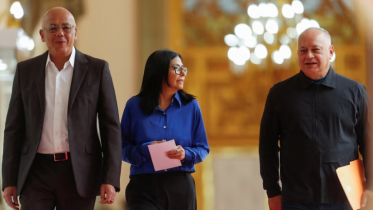
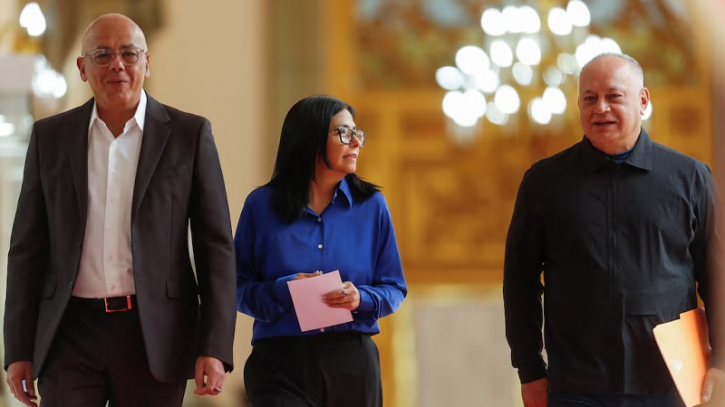
The country's acting President Delcy Rodriguez, National Assembly Speaker Jorge Rodriguez and Interior Minister Diosdado Cabello (from left).
The Trump administration began contacting the country's hardline Interior Minister Diosdado Cabello months before the recent US operation to arrest Venezuelan President Nicolas Maduro, according to multiple sources familiar with the matter. According to them, the United States has continued to contact Cabello even after the raid.
The British news agency Reuters reported this information in a report on Saturday (January 17). The report said that four sources involved said that Trump administration officials warned Cabella, 62, not to use the security forces under his control or armed supporters of the ruling party to target Venezuelan opponents. Cabello's security structure, which includes intelligence agencies, police and the armed forces, remains largely intact after the January 3 US raid.
Cabello is also named in the US drug trafficking indictment that the Trump administration brought to arrest Maduro. However, Cabello was not detained during the raid. Sources say that Cabello's contacts with the US have also raised the issue of sanctions and prosecution against him. The contacts began at the beginning of the current Trump administration and continued until just before Maduro's removal. Four sources confirmed that the contacts have continued even after Maduro's removal.
These secret contacts are considered crucial for the Trump administration to control the situation inside Venezuela. According to one source, if Cabello activates the forces under his control, it could create instability throughout the country, which the US wants to avoid and could also threaten the efforts of interim President Delcy Rodriguez to retain power.
It is unclear whether Cabello’s talks with the US have discussed Venezuela’s future governance. Similarly, it is not known to what extent he has heeded the US warnings. However, Cabello has publicly declared his solidarity with Rodriguez, whom Trump has praised.
While the US sees Rodriguez as the centerpiece of Trump’s strategy for a post-Maduro Venezuela, Cabello is widely believed to have the power to control the situation or derail the entire plan. Cabello has been in contact with the Trump administration directly and through intermediaries, one source said.
All of the sources spoke on condition of anonymity to discuss the sensitive discussions. The White House and the Venezuelan government did not immediately respond to requests for comment.
Cabello, a close Maduro loyalist, Diosdado Cabello has long been considered the second most powerful man in Venezuela. He is widely regarded as one of Maduro's most trusted allies after Chavez, a close ally of the late President Hugo Chavez and considered Maduro's political mentor. Although both Rodriguez and Cabello have been at the heart of the government, parliament and ruling Socialist Party for many years, they have never been known as close allies of Maduro.
A former military officer, Cabello has wielded considerable influence over the country's military and civilian counterintelligence agencies, which play an active role in domestic surveillance. He is also closely associated with pro-government militia groups, particularly the "Colectivos," which are armed civilian groups that have been used to attack protesters in the past.
Cabello is seen by the United States as one of the few Maduro loyalists who can be relied upon to maintain stability in the oil-rich OPEC member country during an uncertain transition period. But US officials fear he could become a “spoiler” in the process, given his repressive past and history of rivalry with Rodriguez.
Rodriguez is already placing loyalists in key positions to strengthen his position and is also complying with US demands to increase oil production, according to a source inside Venezuela who spoke to Reuters.
“Many Venezuelans hope that Cabello will be removed as the democratic transition progresses. When and if he leaves, Venezuelans will know that the regime is truly changing,” said Elliott Abrams, who served as Trump’s special envoy to Venezuela during his first term.
.png "Advertisement")