.png)
Technology Can Assist, But Human Judgment Still Shapes World Cup
Published: 07:15 PM, 25 June 2026
Yet the 2026 FIFA World Cup is once again demonstrating a fundamental truth: no matter how advanced the technology becomes, the final decision still rests with human beings.
One of FIFA's most discussed rule changes at this World Cup concerns players covering their mouths during confrontational exchanges with opponents. Under the new guidelines, referees have the authority to issue a straight red card if a player deliberately covers his mouth while engaging in a heated or hostile interaction.
Before the tournament began, FIFA's head of refereeing, Pierluigi Collina, clarified that covering one's mouth is not banned outright. Players remain free to do so during ordinary conversations. The offence applies only when the act occurs in a confrontational context.
Paraguay's Miguel Almiron became the first player penalised under the rule after being sent off against Turkey following a VAR review. Yet the application of the regulation has already raised questions. During England's goalless draw against Ghana on Tuesday, Jude Bellingham was seen speaking to Jordan Ayew while covering his mouth, but no disciplinary action was taken. Officials determined that the exchange did not constitute a confrontation.
The incident highlights a broader issue. Where exactly is the line between a friendly conversation and a hostile confrontation? If a player deliberately covers his mouth, how can match officials know with certainty what was said? What if offensive language is used without aggressive body language or without a complaint from the opposing player?
Ultimately, such decisions rely more on interpretation than on objective evidence.
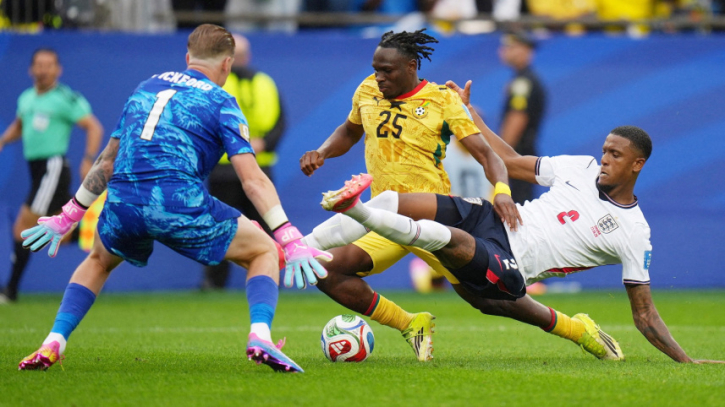
The England-Ghana match produced another controversial moment. Ghana argued they should have been awarded a penalty after defender Ezri Konsa appeared to bring down Prince Kwabena Adu inside the box without touching the ball. Television replays seemed to support the claim, yet neither the on-field referee nor VAR intervened.
Ghana coach Carlos Queiroz did not hide his frustration after the match.
"It felt once again like VAR had gone for a coffee break," he remarked sarcastically. "I'm not even sure VAR still exists at this World Cup. Is VAR really there? Is it working properly?"
Such frustrations have surfaced repeatedly throughout the tournament. Lionel Messi, for example, escaped punishment after a challenge on Algeria's Aissa Mandi that many observers believed warranted at least a yellow card, if not a red. Similar incidents in domestic and international competitions have frequently resulted in harsher sanctions.
Questions have also been raised about consistency. Uzbekistan's Azizjon Ganiyev had a superb goal disallowed against Portugal because of a foul earlier in the attacking move. Yet analysts noted similarities to a challenge involving Argentina's Alexis Mac Allister against Algeria, which went unpunished before Argentina scored.
Of course, refereeing controversies are nothing new in World Cup history. From disputed decisions during the 1934 World Cup in Italy and the 1978 tournament in Argentina to contentious matches involving Belgium and the Soviet Union in 1986, England and Cameroon in 1990, and South Korea's remarkable run to the semi-finals in 2002, debates over officiating have long been part of football's biggest stage.
One of the most famous examples came in 2010 when Frank Lampard's shot against Germany clearly crossed the goal line but was not awarded. That incident became a major catalyst for the introduction of goal-line technology, which has since virtually eliminated such disputes.
Similarly, the introduction of VAR at the 2018 World Cup was intended to reduce officiating errors. In many respects, it has succeeded. Clear offside mistakes have become far less common, and goal-line controversies have largely disappeared.
However, technology can only provide information. The interpretation of that information remains in human hands.
Whether on the pitch or in the VAR room, referees must still make subjective judgments. Those decisions can be influenced by individual perspectives, differing interpretations of the laws of the game and, at times, the pressure created by high-profile teams and star players.
That may be the uncomfortable reality of modern football. Technology has undoubtedly reduced errors, but it has not eliminated controversy. As long as human judgment remains the final authority, debates over fairness, consistency and bias are likely to remain an inseparable part of the World Cup.
MMR
.png "Advertisement")