.png)
A New Alliance in a World of Mistrust
Published: 09:00 PM, 16 August 2026
Zahedul Islam Al Rayyan Zahedul Islam Al Rayyan
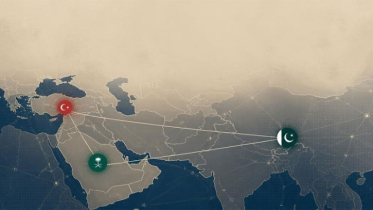
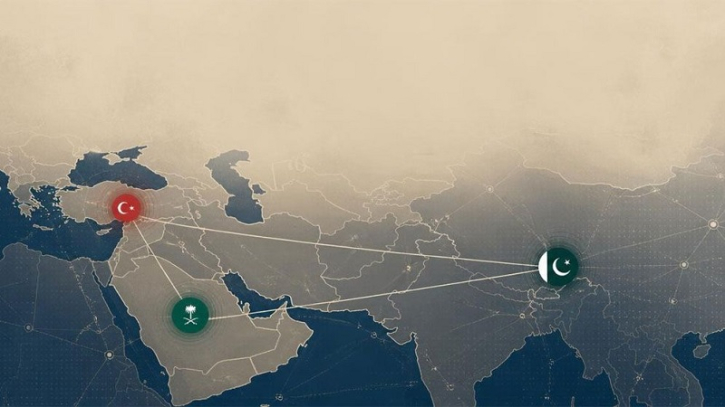
Saudi Arabia, Turkey and Pakistan recently signed a defense pact that some are already calling an ‘Islamic NATO’. But the reality behind this attractive title is much more subtle, much more calculated.
Its real importance probably lies in creating strategic alternatives, mutual cooperation in the defense industry and expanding the scope of each state’s own decision-making.
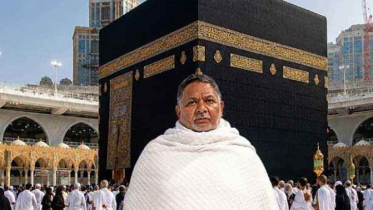
The scene of the event in Mecca was a bit dramatic. Before Turkish President Recep Tayyip Erdogan landed in Saudi Arabia, the Pakistani prime minister and army chief performed Umrah. A few hours later, Shehbaz Sharif, Erdogan and Mohammed bin Salman signed a defense pact that states that an armed attack on any of the three countries will be considered an attack on all three.
This symbolic message needs no further explanation. The gathering of three powers, the holiest city in Islam, the only nuclear-armed state in the Muslim world, NATO’s second-largest army and the Gulf’s deepest strategic treasury, naturally drew comparisons to NATO’s Article 5.
As the comparisons began, so did the speculation. Pakistan’s geopolitical importance often depends more on what the country can actually do than on how enthusiastically television pundits imagine it can do.
As a result, the agreement quickly became a symbol of the revival of the “Islamic bomb”, a possible Muslim NATO, and even, according to some television channels, a collective defense shield against Israel, India and Iran, almost the entire world.
Turkey also came forward with its familiar mix of neo-Ottoman passion and strategic ambiguity. And in some quarters of the Arab world, the agreement was seen as evidence that the Muslim world was finally learning to ensure its own security without waiting for permission from Washington.
The story is undoubtedly fascinating. But the reality, especially in Islamabad’s media, is far more complex.
The Mecca agreement is undoubtedly important, but its importance lies not in the fact that Saudi Arabia, Turkey and Pakistan have suddenly formed a military alliance in which one country is ready to fight another. Rather, its significance lies in the exact opposite.
The three states, whose interests, risks and relations with the United States are quite different from each other, now feel that regional security has become so precarious that they need additional strategic “insurance”.
And at the same time, they want to ensure that they have complete freedom to decide when and how to use that insurance.
What the agreement actually changes
This subtle difference is the most important. When Iranian missiles and drones struck Saudi Arabia’s energy infrastructure, Pakistan still had a mutual defense treaty in force with Saudi Arabia.
Pakistan strongly condemned the attack, reiterated its “unwavering” support, and did exactly what states usually do when faced with the prospect of real war, with statements of brotherhood.
No Pakistani aircraft attacked Iranian targets, no Pakistani troops crossed the Gulf. The “Islamic bomb” remained in its place.
Later, when the Houthis threatened commercial shipping in Saudi Arabia and the Red Sea, Islamabad spoke in terms of international law, solidarity, and regional security.
However, it drew a clearer line on the issue of Pakistani-flagged ships and its own maritime interests. The Foreign Office warned that any attack on these could lead to the legitimate use of force under the right of self-defense. This difference in wording says it all. Pakistan is ready to defend Pakistan, but the rest is up for negotiation.
Turkey is unlikely to act any differently. Ankara has no interest in fighting Iran on Saudi Arabia’s behalf. Similarly, Islamabad will not want to risk a new conflict on a border that already runs through volatile Balochistan.
Both Turkey and Pakistan have a complex but essential relationship with Tehran. This is why calling the Mecca Accord a “Sunni NATO” is more misleading than it is factual.
NATO’s power is not limited to Article 5. It is backed by a unified military structure, decades of mutual military capabilities and communications, a permanent command, joint planning, and, above all, the strategic security assurance of the United States.
These structures do not automatically arise when the three leaders sit in a fancy meeting room and declare that “an attack on one is an attack on all.” The actual structure of the Mecca Accord is also largely unclear. There is no published unified command structure, no mechanism for automatic military response, and no evidence that the three countries have given up their sovereign power to decide when or how to intervene militarily. And in reality, it would not have been particularly wise for them to do so.
Riyadh is actually buying alternatives
Saudi Arabia has realized anew in the past few months how helpless a state can be despite its vast wealth. Riyadh's hands
.png "Advertisement")