.png)
Modi to visit Israel again, India’s new move in Middle East politics
Published: 06:56 PM, 22 February 2026
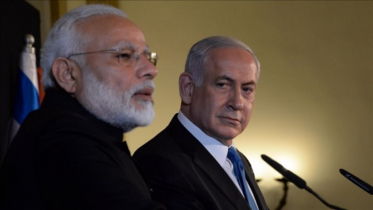
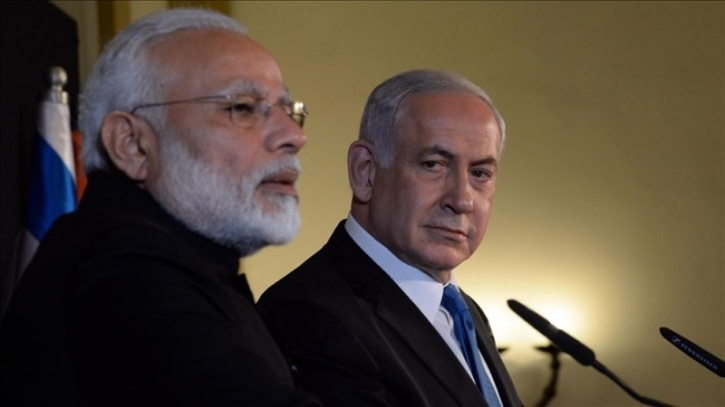
Indian Prime Minister Narendra Modi is going to Israel on a two-day state visit on Wednesday (February 25).
This is his second visit to Israel after 9 years. His first visit in 2017 was the first by an Indian Prime Minister to Israel. Modi's visit is taking place at a time when more than 100 countries, including India, have condemned Israel's settlement construction in the occupied West Bank.
Although India and Israel have developed close ties in defense, security, trade and technology in recent years, analysts believe that New Delhi's support for the long-standing struggle of the Palestinians has waned somewhat compared to before.
This closeness between India and Israel was not always like this. In the 1930s and 40s, India, under the leadership of Mahatma Gandhi and Jawaharlal Nehru, strongly supported the Palestinian struggle for independence. In 1938, Gandhi wrote, Palestine is to the Arabs what England is to the English.
In 1947, India voted against the UN partition plan for Palestine and in 1949, it also opposed Israel's admission to the UN. Although India recognized Israel as a state in 1950, it did not establish formal diplomatic relations for the next four decades, out of concern for Arab sentiment and Palestinian interests.
In the 1960s and 1970s, India's open support for the Palestinians was accompanied by a secret military relationship with Israel. Israel provided India with arms and ammunition during the 1962 Sino-Indian War and the 1965 Indo-Pakistani War.
However, India was still hesitant to grant diplomatic recognition to Israel. In 1974, India became the first non-Arab country to recognize the PLO as the sole representative of the Palestinian people, and Indira Gandhi had a very close relationship with Yasser Arafat.
India established full diplomatic relations with Israel for the first time in 1992, during the PV Narsingh Rao government. Israel's supply of laser-guided bombs and missiles during the 1999 Kargil War played a key role in India's victory.
This relationship came to a complete standstill after Narendra Modi came to power in 2014. India is now Israel's second-largest trading partner in Asia and a major buyer of Israeli defense equipment. Thousands of Indian workers are even being deployed in Israel to fill the shortage of Palestinian workers due to the Gaza war.
According to analysts, the Modi government is currently trying to maintain a strategic balance. On the one hand, defense and economic ties with Israel are being deepened, while on the other hand, formal support for the 'two-state solution' to the Palestinian question has been maintained.
Although India has abstained from voting on some resolutions against Israel at the United Nations, it has remained vocal in criticizing the Israeli occupation of the West Bank. Modi's visit is a reflection of India's growing influence in the international arena and its sophisticated diplomatic strategy in the Middle East.
Source: Al Jazeera.
.png "Advertisement")