.png)
50 fighter jets deployed in the Middle East in 24 hours, what else is in the US military fleet
Published: 07:28 PM, 19 February 2026
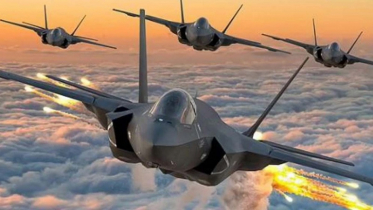
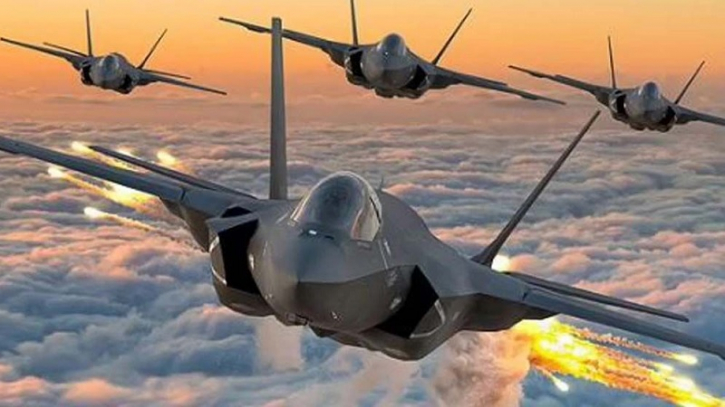
The US military is preparing to strike Iran at any time. Washington has sent a large fleet of state-of-the-art F-35 and F-22 Raptor stealth fighter jets to the region to crush Tehran's nuclear program and missile power. Through this, the United States has made the largest gathering of air power in the Middle East since the Iraq war two decades ago. It is accompanied by a large fleet of warships.
This is the first time since the 2003 invasion of Iraq that such a large number of US warplanes have been seen in the skies of the Middle East. This fleet is being joined by another aircraft carrier loaded with electronic warfare aircraft and command and control fighter jets, which are essential for conducting major military operations. Now it only awaits the final approval of President Donald Trump.
Trump is reported to have not yet made a final decision on whether to attack Iran or not. The White House is also actively analyzing whether the attack is aimed solely at destroying Iran's nuclear and missile facilities or at toppling the current regime in Tehran.
Flight tracking data shows that dozens of US Air Force fighter jets are stationed at Mu'affak Salti in Jordan and Prince Sultan Air Base in Saudi Arabia. These include powerful fighter jets such as the F-35, F-15, F-16 and F-22 Raptor. In fact, at least 50 state-of-the-art fighter jets have been deployed to the Middle East in the last 24 hours.
The Navy is not far behind. It has deployed 13 ships to the Middle East and the eastern Mediterranean. These include the aircraft carriers 'USS Abraham Lincoln' and 'USS Gerald R. Ford' and a fleet of destroyers.
Although the current readiness is strong, it is limited compared to 1991 or 2003. However, due to technological advancements, it is now possible to carry out much more precise and devastating attacks with a small number of warplanes.
With this fleet arranged by Trump, it is possible to carry out air strikes on Iran for several weeks. However, the challenge this time is that Saudi Arabia and the United Arab Emirates have not allowed the use of their airspace for the US attack.
Amidst military preparations, talks are underway in Geneva between Iranian and US representatives on the nuclear program. The White House said that although some progress has been made in the talks, major differences still remain. Although the US military is ready to attack this weekend, Trump is personally in doubt about the pros and cons of this operation.
Iran is also not sitting still. Tehran will use its huge missile arsenal to respond to a possible US attack in an unprecedented manner. Through this, it can target US military bases in the Middle East. In addition, Iran has threatened to close the 'Strait of Hormuz' to disrupt the global oil market.
News from NDTV, CNN and the Wall Street Journal.
.png "Advertisement")