.png)
Iran’s homegrown drone has given a new dimension to war
Published : 05:07 PM, 13 December 2025
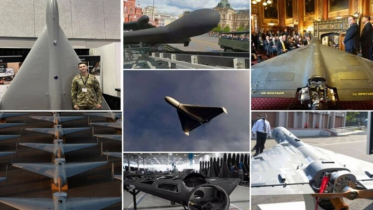
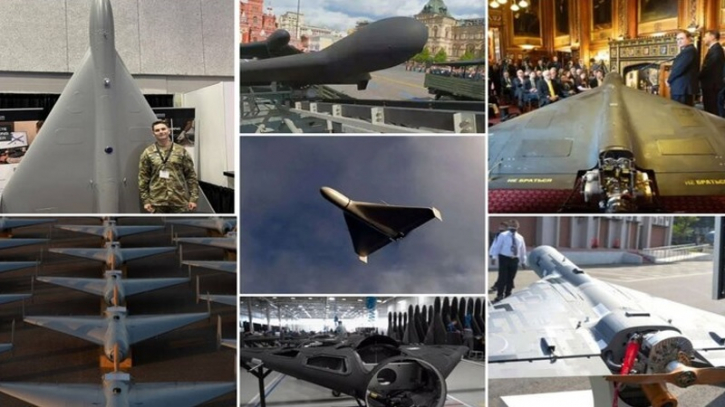
Iran's homegrown Shahed-136 drone has rewritten the rules of silent drone warfare. As a result, military powers around the world are being forced to think anew about achieving dominance and strategy on the battlefield.
While superpowers like the United States, China, and Russia, which dominate the global arms market, have traditionally been considered the best in military innovation, Iran's Shahed loitering munition has emerged as an exceptional and influential force.
Small in size, relatively low in cost, and built with functionality over technology demonstration in mind, this drone has redefined the economics and tactics of modern warfare. Its rapid rise from a locally developed platform to an international standard has forced the world's top military industries to directly imitate it, indicating a shift in the global strategic calculus.
At the heart of this change is the design philosophy of the Shahed-136. Features such as a simple piston engine of only 50 horsepower, a capacity to carry a warhead of about 40 kg, and a range of approximately 2,000 km reflect a vision where cost-effective and reliable performance is more important than complexity.
With the drone’s estimated cost per unit of just $20,000 to $50,000, it poses an operational challenge that is difficult for even the most expensive air defense systems to address. The low cost of production versus the high cost of deterrence puts Iran in a unique position in the global drone war.
The greatest evidence of the Shahed drone’s impact is that superpowers that once viewed Iran as a secondary or marginal power are now adopting and emulating it. The United States, which has long had a policy of “inventing here” or self-inventing its own systems, has launched its own reverse-engineered version through the Pentagon’s “Scorpion Strike” task force.
The new system, built at a price close to the Iranian model and suitable for massed attacks, signals a major shift. The cost-effective Shahed also calls into question Washington’s extensive expensive technological capabilities.
Russia, recognized as one of the world’s most advanced drone developers, has incorporated Iranian innovations into its “Zeran-2” version. With improved engines, radar-evading equipment, AI capabilities, and advanced anti-jamming antennas, the version is well-suited to the multi-layered air-defense environment of the Ukrainian battlefield. Despite Russia’s extensive domestic UAV program, the Shahed model fills a gap in its arsenal. In particular, it is capable of defeating Western defenses built on expensive, long-range attack systems.
China has also joined the trend. Tests of the Long M-9 drone, whose delta-wing structure and mission profile are strikingly similar to the Shahed, demonstrate Beijing’s support for the Shahed drone.
The Shahed’s invention and the Chinese-Russian drone development that centered around it have created a deep conflict at the heart of global defense innovation. As countries with large military budgets are constrained by institutional inertia, long procurement cycles, and high production costs, Iran, forced to prioritize self-reliance amid sanctions, has developed a drone model that privileges functionality, scalability, and battlefield practicality. The Shahed-136 has thus become more than just a drone; it is a demonstration of how strategic necessity can outweigh financial expediency.
The widespread replication of the system underscores a broader evolution in modern warfare. The Shahed-136’s ability to complement air-defense systems, forcing adversaries to spend expensive interceptors, challenges long-held assumptions about technological superiority and battlefield deterrence.
The rise of the Shahed-136 highlights a fundamental truth. And that is that innovation is not just the domain of wealthy nations. In this case, Iran has turned resource constraints into an advantage, creating a platform that powerful militaries around the world now study, forcing them to reverse-engineer.
Source: Mehr
.png "Advertisement")