.png)
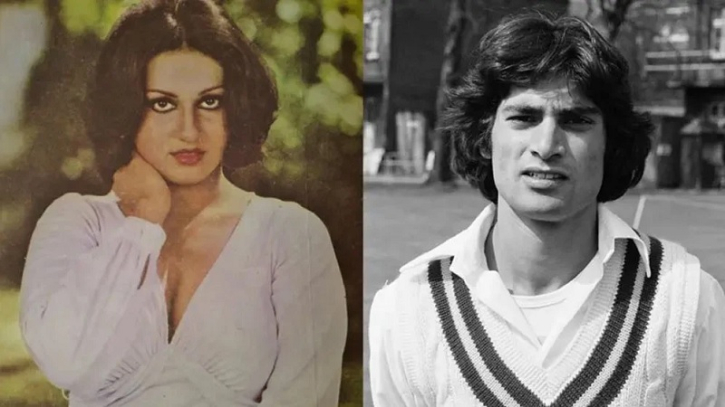
From cricket to Bollywood, love with Reena Roy - The story of Pakistani cricketer Mohsin Khan
Published: 02:52 PM, 7 September 2026
It was September 1983. The first Test match between Pakistan and India in Bangalore had not yet begun. In the meantime, a famous Indian film director expressed his desire to meet a famous Pakistani cricketer.
When he met the cricketer, he offered him a role in his film and said, "I have a role for you."
In response, the cricketer said, "You know, I am very busy with cricket at the moment. I want to play for my country as long as possible. But after I quit cricket, I promise you, I will act in this (character)."
These two words ended the brief encounter. But a few days later, the two met again in Mumbai.
At that time, the director reminded the cricketer of his promise and said, "The content of the film is very good. I have already cast Dharmendra and Vinod Khanna. I want to cast you as the third hero in this film."
And it was after this conversation that the cricketer entered the glittering world of Bollywood. That Pakistani cricketer was Mohsin Khan, and the director was JP Dutta.
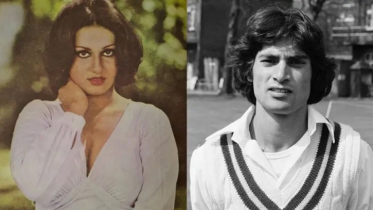
The story of JP Dutta and Mohsin Khan remains incomplete without another name. That name is Reena Roy.
Actress Reena Roy and JP Dutta were friends. In fact, it was Reena Roy who played the biggest role in starting and taking Mohsin Khan's film career forward.
Mohsin Khan and Reena Roy first met in London. At that time, Mohsin Khan was playing league cricket in England and Reena Roy had gone there with Mohsin Khan's sister.
Mohsin Khan was introduced to Reena Roy by her sister. She said that Reena Roy is one of the top heroines of Indian cinema.
Love and breakup with Reena Roy
However, Mohsin Khan had no particular interest in films. The world knew him only as a stylish cricketer.
Speaking to the media, Mohsin Khan said, "Before marrying Reena Roy, I had never seen any of her films. My interest in films was so great that if I saw a scene of Amitabh Bachchan on the television screen while leaving the house, I would stand and watch it for a few moments. Apart from that, I hardly watched any films."
Mohsin Khan and Rina Roy's friendship gradually turned into love. Then they got married in 1983.
However, before this, cricketer Nawab Mansoor Ali Khan Pataudi and actress Sharmila Tagore had married in India. Later, many other cricketers married actresses. But the incident of a Pakistani cricketer choosing an Indian actress as his life partner was completely unprecedented at that time.
At that time, both were at the peak of their careers. Reena Roy's life journey began as Saira Ali, later she became Rupa Roy and finally came to be known as Reena Roy. This name was given to her by filmmaker B. R. Ishara.
After many ups and downs and some failures in his film career, his name was associated with successful films like 'Naagin', 'Asha' and 'Kalicharan'.
After marriage, Reena Roy withdrew from the film industry and started living in Pakistan. But later, there came a time when Mohsin Khan and Reena Roy decided to go their separate ways.
Their divorce in the early 1990s made as much headlines in the press as their marriage, which was also a huge success.
After the separation, Reena Roy returned to India. She resumed acting in films. Later, she was also seen as a guest on various television shows.
They also have a daughter, who was initially named Jannat. She was later named Sanam Khan.
There was also a legal battle between them over the custody of their daughter. Initially, the girl stayed with her father, but later she moved to her mother.
In an interview, Mohsin Khan said, 'I married a man not for his beauty or fame, but for his character and good manners. I had not seen any picture of Reena Roy before marriage. No one may believe me, but it is true.'
Mohsin Khan's film career
Mohsin Khan's experience working on 'Bantwara' was quite interesting. The cast of this film included big names like Dharmendra, Vinod Khanna and Shammi Kapoor.
It was not an easy task to act in front of them, especially for someone who had no prior acting experience. However, JP Dutta's guidance and advice made it much easier for Mohsin Khan to play the role of a police officer.
JP Dutta explained a scenario to Mohsin Khan in the language of cricket. He said, 'Suppose you score a century, but your team still loses. In such a situation, how do you understand the feeling of pain more than joy?'
It was a moment of joy for Mohsin Khan when he was nominated for the Filmfare Award for Best Supporting Actor for his performance in the film 'Bantwara'.
He was also nominated in this category along with Nana Patekar, Vinod Khanna, Amrish Puri and Pankaj Kapur. In the end, Nana Patekar won the award for the film 'Parinda'.
Personally, Mohsin Khan's favorite film is 'Saathi'. This film was directed by Mahesh Bhatt.
Mohsin Khan told the media, "Bhatt Sahib is a very wise man. Sitting with him, one can understand the philosophy of life very well."
Mohsin Khan liked many aspects of the film 'Saathi'. He was also deeply impressed by the song 'Zindegi ki talash mein hum, maut ke kitane paas a gaye' sung by Kumar Sanu.
Mohsin Khan has acted in 13 Bollywood films. 'Mahanata', released in 1997, was his last Bollywood film.
Mohsin Khan has also acted in several Pakistani films. His first film was 'Raaz'. In this film, his co-star was popular actress Babra Sharif. He also played the lead role in the film 'Piyasa Sawan' with Babra Sharif.
His other Pakistani films include 'Hathi Mere Saathi', 'Jannat', 'Insaniyat', 'Beta', 'Sab Ke Baap', 'Choro Ke Baap', 'Ghunghat', 'Dil Tera Aashiq' and 'Chalti Ka Naam Gaadi'.
His last released film in Pakistan was 'Saala Bigra Jaye', which was released in 1999. Most of Mohsin Khan's films failed at the box office.
Mohsin Khan was born into an educated and respectable family. His father was an officer in the Pakistan Navy, and his mother was a teacher and vice principal.
On the one hand, he was taught discipline, and on the other hand, he was also fully focused on his studies. These two qualities beautifully shaped Mohsin Khan's personality.
His father also represented the hockey team of the Garh University. He was also a sportsman himself, so he encouraged Mohsin Khan to take up sports.
As a result, Mohsin Khan participated in almost all types of sports during his student life. He even became Pakistan's National Junior Badminton Champion.
However, his subjects of study in college were physics, chemistry and mathematics. Therefore, more importance was given to studies. He played cricket only nominally.
Due to a shortage of players in a match, physics teacher Mukarram Sherwani, who also served as a sports teacher, asked him to play a match for the college team. In that match, he scored a century.
One of the umpires in that match was Umar Khan, a former first-class cricketer and Test umpire.
After watching Mohsin Khan's batting, he advised him to take cricket seriously. After that, Mohsin Khan's relationship with cricket in the true sense developed.
He also scored a triple century while playing at the Under-19 level. He then played first-class cricket for Karachi and Pakistan Universities teams.
Historic double century at Lord's
Mohsin Khan began his Test career at a time when Pakistan's star cricketer Kerry Packer was joining cricket.
Wasim Warri had to captain a Pakistan team that was relatively inexperienced at the time. Later, when the star cricketers returned to the team, Mohsin Khan had to work hard to cement his place in their crowd.
Mohsin Khan was among those who rebelled against Javed Miandad's captaincy at this time.
It was Mohsin Khan's first real confidence-building came with his century against Sri Lanka in the 1982 Lahore Test.
But greater success was yet to come, culminating in his magnificent double century at the historic Lord's that same year.
The innings was a collection of beautiful shots. Those who watched that innings could not help but praise them.
This innings laid the foundation for Pakistan's first victory at Lord's. Mudassar Nazar then went on to earn widespread acclaim as the 'golden arm' bowler, taking six wickets. But the test was not over yet.
Pakistan needed just 76 runs in 18 overs to win. At that time, the team's biggest opponent was the adverse weather.
In this situation, Mohsin Khan and Javed Miandad started scoring runs at a rapid pace. The two of them took Pakistan to the brink of victory in just 13.1 overs.
1982 was the best year of Mohsin Khan's cricketing career. That year, he made history by becoming the first Pakistani batsman to complete 1,000 runs in a calendar year.
In addition to his double century at Lord's that year, he also scored Test centuries against India, Australia and Sri Lanka. Notably, all three of these centuries came in Lahore.
The chance of not being able to meet Don Bradman
Another memorable series for Mohsin Khan was against Australia in the 1983-84 season. In that series, he played two impeccable innings of 149 runs in Adelaide and 152 runs in Melbourne.
This was the first time a Pakistani batsman had scored centuries in consecutive Test matches on Australian soil. He played these courageous innings against a bowling attack that included fearsome pace bowlers like Dennis Lillee, Rodney Hogg, Jeff Lawson and Carl Ruckman.
However, Mohsin Khan still has one regret: he was unable to meet the legendary Sir Don Bradman during that innings in the Adelaide Test.
Don Bradman was sitting in his special box watching Mohsin Khan bat. But before Mohsin could complete his century, Bradman had to leave the stadium due to physical illness.
As a result, Mohsin's dream of meeting one of the greatest batsmen of all time remained unfulfilled. However, Ian Chappell later told him that whenever Bradman watched him bat, he was deeply impressed. Bradman's comment was, 'This boy really knows how to bat.'
Similarly, Dennis Lillee told Imran Khan about Mohsin Khan after he played a brilliant innings in Melbourne, 'Today I bowled to one of the best batsmen in the world.'
When Imran Khan told Mohsin Khan about the comment, he asked, "Are you saying this just to please me?" In response, Imran Khan said, "No, it's absolutely true."
Argument with the chief selector
A dramatic incident during the Lahore Test against England in 1984 became one of the most talked about chapters in Mohsin Khan's cricketing career. Before Pakistan's second innings had even begun, news broke that he had been dropped from the ODI squad that would follow the conclusion of the Test series.
Not only that, the Pakistan Cricket Board had already prepared a press release announcing the team. What was even more surprising was that the selectors did not even wait for the Test match to end. There was still an innings left in the match.
Initially, Mohsin Khan was unaware of the decision. He found out about it just as he was preparing to come out to bat in the second innings.
In this situation, his only goal was to play an innings that would prove the selectors wrong. He achieved that goal by playing a magnificent century. That century with his bat forced the selectors to reconsider their decision.
Mohsin Khan later recalled, "When I returned to the dressing room after scoring a century, everyone was congratulating me. I was told that the team was supposed to be announced after the match. But after my century, the announcement was postponed."
He added, "At that time, the chief selector also came to me and said, 'I am very happy with your performance. I hope you play the same way in the next series too.'"
However, the chief selector was surprised to hear Mohsin's answer. Mohsin countered by asking, "Have you asked me if I am available to play in the next series?"
The chief selector then said, 'I don't understand why you are talking to me in this manner.'
In response, Mohsin Khan said in clear terms, "Keep these words to yourself. You can't fool anyone." He even said that he would decide in about an hour whether to play in the next series, and if he wanted, the selectors could wait for that decision.
The chief selector with whom Mohsin Khan had this bitter conversation was the then chief selector of the Pakistan team, Haseeb Ahsan.
Successful partnership with Mudassar Nazar
In 2008, Wisden published a list of the 10 best opening pairs of all time based on Test cricket performance. Mohsin Khan and Mudassar Nazar were recognized as the ninth best opening pair in that list.
Opening together in their Test careers, the duo amassed a total of 2054 runs in 54 Test innings. They had three centuries and 16 half-century partnerships.
At the time, it was one of the most successful opening pairs in international cricket. Beyond the statistics, the success of Mohsin Khan and Mudassar Nazar was largely due to their extraordinary mental understanding and deep understanding of each other's style of play.
Pakistan cricket had never seen such close coordination before between the opening pair of Majid Khan and Sadiq Mohammad. The Mohsin-Mudassar pair took that tradition to new heights and carved out a special place for themselves in Pakistan's batting history.
From celluloid back to the world of cricket
After saying goodbye to Bollywood, Mohsin Khan renewed his relationship with cricket.
He later served as the chief selector of the Pakistan cricket team and also served as the head coach of the national team for a while. One of his greatest achievements as a coach was the whitewash of the world's number one team, England, in a Test series.
Misbah-ul-Haq was the captain of that Pakistan team. Under Mohsin Khan's coaching, the Pakistan team achieved significant success in all three formats, Tests, One-Day Internationals and T20s, during its tours to Sri Lanka and Bangladesh.
He also served as the chairman of the Pakistan Cricket Board's cricket committee, which included Wasim Akram, Misbah-ul-Haq and Uruz Mumtaz.
Mohsin Khan was only 31 years old when he ended his first chapter as a cricketer. At that time, many openers in the world were under pressure, facing terrible pace bowling.
But Mohsin Khan's batting exuded confidence. Even in difficult situations, he batted with a natural and fluent style.
His personality and style, along with his captivating strokeplay, were the talk of the cricketing world. Wearing a white kit and a cap on the field, he created a distinct and distinctive presence from his teammates.
Perhaps it was his aristocratic personality and star-like charm that took him beyond the cricket field to the world of Bollywood. Success as a cricketer, popularity on screen, and later contributions as a coach and administrator, Mohsin Khan's life is an example of a rare multi-dimensional sporting journey.
When asked which is more difficult, cricket or films, Mohsin Khan clearly stated that he finds cricket more challenging.
In his words, 'Neither job is easy. But cricket is much more difficult, because every performance here is done live in front of an audience and there is no room for mistakes.'
He further said, "On the other hand, there is the advantage of re-takes during film shooting. Even if you make a mistake not once, but multiple times, there is no problem. In the end, the best scene can be chosen. But in cricket, there is no such opportunity. What you do on the field is the final decision."
Mohsin Khan's comments reflect his experiences in two different worlds in life.
Apart from playing at the top level of international cricket, he has also worked successfully in Bollywood. As a result, he has seen the difference in pressure, preparation and mentality between the two fields very closely. According to him, just as skill and hard work are important in acting, in cricket, the ability to make decisions in the moment, mental toughness and give perfect performance under pressure face a tougher test for a player.
.png "Advertisement")