.png)
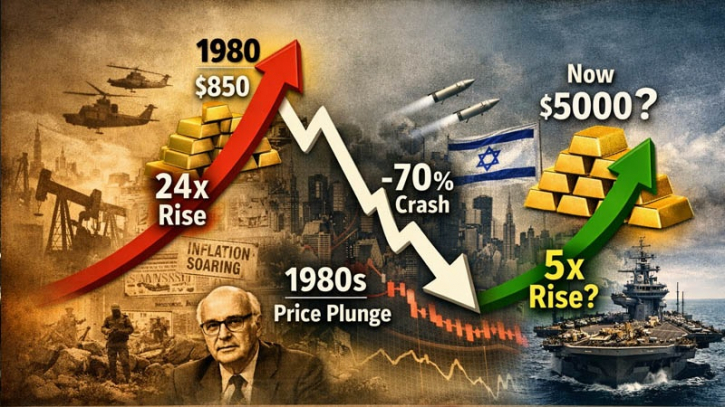
Although it has increased 5 times now, the price of gold has only increased 24 times in history, what happened next
Published: 06:53 PM, 4 February 2026
Recently, the price of gold has been increasing in the global market. In the last 20 years, the price of gold has increased by about 840 percent, which is almost 9 times. And in the last decade, the price has increased by about 360 percent, which is almost 4.5 times. Its negative impact is also clear in Bangladesh; almost every day, the price of gold is setting new records, breaking previous records. The question arises - will this rise continue, or is there a risk of a major price decline like history?
To find the answer to this question, we have to look back to the most dramatic chapter in the history of gold - the historical rise and fall of 1980. Historically, before 1971, the price of gold in the world was almost stable. Because, for a long time after World War II, the world economy was operating under the Bretton Woods system, where the price of gold was practically administratively fixed - $ 35 per ounce. As a result, there was little to say about the price of gold in the previous few decades. The market had no room for price fluctuations.
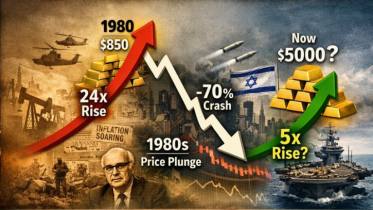
In 1971, the United States severed the direct link between gold and the dollar. As a result, gold entered the free market for the first time. In this sense, the rise of the 1970s was the first major explosion in the free market era of gold. Over the next nine years, between 1971 and 1980, the price of gold rose from $35 an ounce to about $850. This was an increase of about 2,300 percent, or about a 24-fold increase in price. No other major asset or precious metal has seen such a jump in such a short period of time in modern financial history.
Several factors worked together to drive this rise. High inflation in the United States and Europe, the oil crisis, the economic uncertainty following the Vietnam War, the Iranian revolution, and the tensions of the Cold War all combined to cause investors to lose confidence in paper money. On the other hand, the demand for gold as a safe haven asset continued to grow.
But the story does not end there. When the price of gold peaked in 1980, the opposite path began. The US Federal Reserve raised interest rates to control inflation, the dollar regained its strength, and demand for gold began to decline alarmingly. The result was brutal - the price of gold fell by about 65-70 percent in the next two decades. Considering the real price, many investors who invested in the peak of 1980 had to wait about 25 years to see the price again with their own eyes. From this historical experience, economists say that the biggest risk in the gold market arises when everyone assumes that the price will 'not go down any further'.
However, the current situation is not the same as in 1980. Today's global economy is more complex and multifaceted. High debt in the United States, Europe and other countries, geopolitical conflicts, global inflationary pressures and massive gold purchases by central banks have all created a strong foundation for gold. In addition, the structure of investment in gold has also changed due to derivatives and ETF digital trading in today's market.
Yet one thing remains the same - although gold is a safe asset in the long term, it can be subject to major fluctuations in the short and medium term. History says that a 5-fold or 9-fold increase is not uncommon, but a 24-fold increase was the most exceptional. And that exception was followed by a prolonged decline and depression.
Ray Dalio, world-renowned investor and founder of Bridgewater Associates, believes that, 'When inflation, the credit crisis and geopolitical tensions increase together, gold becomes a safe haven for people. However, history shows that if the price increases too quickly due to excessive excitement, a major correction or fall becomes inevitable at some point.'
Nouriel Roubini, an economist and professor at New York University, said, 'While the price of gold is a means of preserving value in the long term, it can become extremely volatile in the short and medium term. The experience of 1980 shows that when the price of gold goes far beyond the real economic base, the market itself ruthlessly restores balance.
This lesson is also important in the context of Bangladesh. Even if the price increases in the local market, it can be said to be a reflection of the global trend. Past experience reminds us that it is not emotions that are most important in investing in gold, but time and risk considerations.
Finally, it can be said that the rise of 1980 was not the rule in the history of gold, but the exception. And what happened after that exception is still the biggest warning for investors today.
.png "Advertisement")