What Are the U.S. Midterm Elections? Key Things to Know
Published: 02:07 PM, 31 October 2026
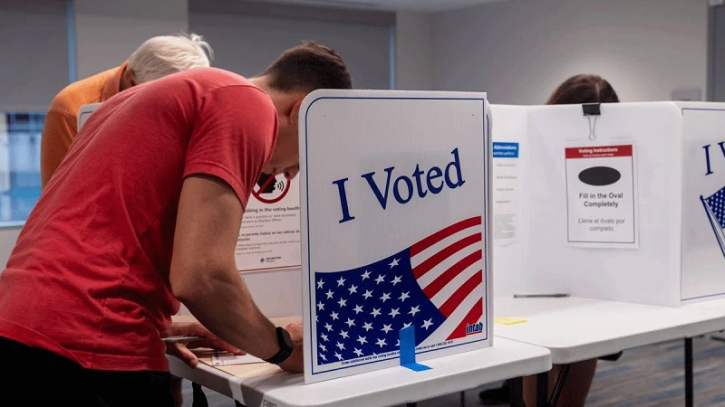
The United States is set to hold its midterm elections on November 3. In this election, approximately 210 million registered voters will determine who will control Congress for the remainder of President Donald Trump’s term.
While Trump himself is not on the ballot, the election will decide which party controls the U.S. Congress—the nation’s legislative body. Comprising the House of Representatives and the Senate, Congress is responsible for enacting laws and overseeing federal government spending.
An analysis by Al Jazeera notes that there is significant speculation regarding how the voting will unfold, which seats are critical, and what the results could mean for both political parties.
What Happens in the Midterm Elections?
Midterm elections take place halfway through a U.S. President’s four-year term. These elections determine the composition and control of both chambers of Congress.
This year, all 435 seats in the House of Representatives and 35 of the 100 seats in the Senate are up for election. This includes special elections in the states of Florida and Ohio—held to fill vacancies left by individuals such as Marco Rubio (now Secretary of State) and J.D. Vance (now Vice President). Additionally, voters in 36 states will elect their governors.
Members of the House of Representatives serve two-year terms and represent specific congressional districts, while Senators serve six-year terms.
Midterm elections are often viewed as a referendum on the performance of the incumbent President.
According to Todd Belt, a professor of political management at George Washington University, the President’s party has lost an average of 26.5 seats in the House of Representatives during midterm elections since 1946. Historically, the party has also tended to lose a number of seats in the Senate.
Beyond the congressional and gubernatorial races, elections will also be held for state legislatures and various local-level positions.
Nadia Brown, a professor of government and politics at Georgetown University, points out that while national elections receive the most attention, most American citizens interact with their government primarily through local politics. He further noted that the local proposals and referendums appearing on the ballot will have a direct impact on people's daily lives.
What is at stake in the House of Representatives and the Senate?
Currently, the Republicans hold the majority in both chambers of Congress. If they lose control of either chamber, the Democrats would gain the power to block legislation and initiate investigations into the Trump administration.
To take control of the House of Representatives, the Democrats need to gain three seats, while they need four additional seats to secure control of the Senate. If the Senate ends up with an even 50-50 split between the two parties, the Republicans will retain control, as Vice President JD Vance holds the tie-breaking vote.
According to Todd Belt, a Democratic victory could significantly limit Trump’s ability to implement his domestic policy agenda.
He told Al Jazeera that if the Democrats take control of either chamber of Congress, the passage of legislation—particularly regarding funding outside of routine government operations—would effectively come to a standstill.
How House of Representatives elections work
The House of Representatives is the lower chamber of the U.S. Congress. Its 435 members each represent a specific congressional district. As their term is two years, elections for all seats are held every two years.
Seats are allocated to states based on their population, as determined by a census conducted every 10 years. California, the most populous state, holds 52 seats, while states with smaller populations, such as Wyoming and Vermont, have one seat each.
To secure a majority in the House of Representatives, a party must win at least 218 seats.
Currently, the Republicans hold 218 seats, and the Democrats hold 214. One independent member aligns with the Republicans. Additionally, there are two vacant seats—one previously held by a Republican and the other by a Democrat.
Members of the new House of Representatives will be sworn in on January 3, 2027. Key Races to Watch
One representative is elected from each congressional district. The party that secures 218 seats will gain control of the House of Representatives. Consequently, the outcomes in even a small number of competitive districts could prove decisive in determining which party holds the majority.
Todd Belt suggests that the results in approximately 35 districts will play a crucial role in determining control of the House. He forecasts that, despite the advantage Republicans gained from the redistricting process—which he estimates provided them an edge in an additional nine districts—Democrats could potentially pick up about 15 seats.
He notes that voters typically cast ballots for candidates from the same party; therefore, national-level political trends can influence the outcomes of individual races.
Districts where both parties have a realistic chance of winning are considered "competitive." This election cycle, attention will be focused on 12 such critical districts.
How Senate Elections Work
The Senate is the upper chamber of the U.S. Congress, consisting of 100 members. Each state elects two senators, regardless of its population. Senators serve six-year terms, with approximately one-third of the seats up for election every two years.
In this election cycle, 33 seats are being contested in regular elections. Additionally, special elections will be held in Florida and Ohio to fill the remaining two years of the terms vacated by Marco Rubio and J.D. Vance.