.png)
Major rivers in Europe are drying up due to intense heat, fear of major danger
Published: 10:35 PM, 6 August 2026
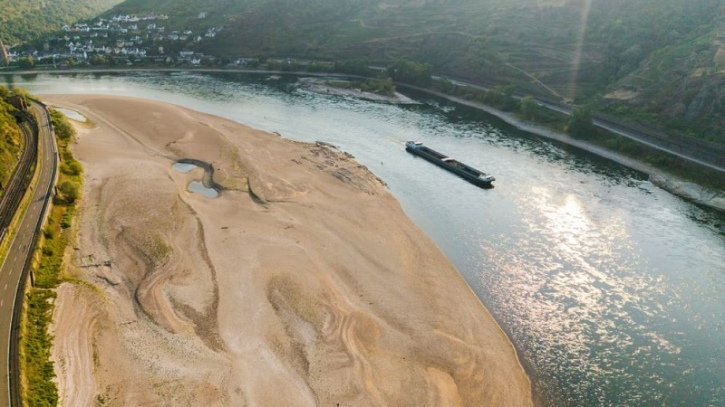
Several important rivers in Europe are drying up due to severe heat waves and lack of rain. The water level has dropped so low that this terrible crisis is clearly visible even from space.
Satellite images show that the once great rivers that flowed through the dry land are now dying. As the water recedes, the vast banks of the rivers and long sandbars hidden under the water have emerged. Comparing them with the normal water flow conditions of 2023, it is clear how deplorable the current state of these important waterways in Europe is.
Europe is the continent that is experiencing the fastest warming in the world. Due to man-made climate change, its summers have become much more extreme than before. One after another, heat waves are sucking moisture from the soil and rivers, and prolonged droughts have made the situation even more dire.
The impact is also huge. Europe’s rivers are not only a major means of transporting goods, but also play a vital role in cooling power plants, generating hydroelectric power, the tourism industry and as a habitat for wildlife. As rivers dry up, people, economies and ecosystems all suffer severe losses.
Europe’s rivers are experiencing summer droughts, but this year they have reached unprecedented levels. The Danube and Rhine, two of Europe’s most important waterways, are in particularly bad shape. The Danube, Europe’s second-longest river, which flows through 10 countries from Germany to the Black Sea, has fallen to a record low in Hungary.
According to the Associated Press, the Danube’s water level in Budapest fell to just 4 inches on Monday, far below the record 13 inches recorded in 2018. This week, temperatures in the city are expected to exceed 100 degrees Fahrenheit (38 degrees Celsius) as a new heat wave hits central and eastern Europe, raising fears that the water level could drop even further.
Europe in Energy Crisis
Hungary is facing a severe energy crisis as the Danube dries up. The country's Paks nuclear power plant, which supplies about half of the country's electricity and uses the Danube for cooling, is now operating at only 10 percent capacity. All but one of the reactors at the plant has been shut down due to a lack of water. If the water level drops further, the entire plant could have to be shut down. Hungarian Prime Minister Peter Magyar has thanked the general public and industrial owners for voluntarily reducing electricity use during peak hours.
Romania is also facing an energy crisis. According to Reuters, the navy used explosives to blow up rocks on Monday to divert water from the Danube River towards the only operating reactor at the Chernovoda nuclear power plant. The country's state water management agency is also planning to build a temporary dam by sinking two barges filled with rocks in a branch of the river to increase the flow.
History peeks under the river
The drying up of the river has also affected the tourism sector. Many river cruises have been canceled. Last week, a cruise ship got stuck on a sandbar in the Danube River in Bulgaria. However, as the water recedes, various historical artifacts are emerging from the bottom of the river. It is believed that the remains of an ancient mammoth were found in northern Bulgaria last week. In addition, a sunken Nazi warship from World War II has risen from the Danube in Serbia.
Big blow to trade
The Rhine River, which originates in the Swiss Alps and flows into the North Sea, is also in critical condition. The river is a major means of transporting goods ranging from food and minerals to coal and oil. Massimiliano Zappa, a hydrologist at the Swiss Federal Institute, said that the decrease in the river's water is due to less snowfall in the Alps in winter, a lack of rain and five different heat waves in the Rhine basin. The water level at the Rhine's most important point near the western German city of Koblenz was just 9 inches on Wednesday. Reuters reported that the previous record low was 9.3 inches in 2018.
The water level has fallen so low that commercial ships have had to reduce their cargo by up to 80 percent for fear of getting stuck on the sandbanks. This has disrupted supply chains and increased transportation costs. A spokesman for chemical company Lanxess told Reuters on Monday that ships are using rail and road instead of river routes because they cannot reach many points for loading and unloading goods. The Rhine's water level in the German cities of Cologne and Lobitz also fell to record lows. In addition, some parts of other European rivers, such as the Po in Italy and the Loire in France, have also experienced abnormally low water levels.
Fears of greater danger ahead
Scientists have warned that new records of river drying will continue to be set in the future. "As the climate continues to warm, the dire situation we are seeing now is just the tip of the iceberg," said Richard Allan, a professor of climate science at the University of Reading in England. "Water resource management will become even more challenging in the future."
He added that the only way to address this extreme situation is to rapidly reduce greenhouse gas emissions across all sectors of society and to adopt long-term policies rather than short-term measures.
Sources: CNN, Reuters, AP
.png "Advertisement")