.png)
Iran’s policy shift proposal: a way out of sanctions, or a risk of weakening deterrence?
Published : 06:40 PM, 14 December 2025
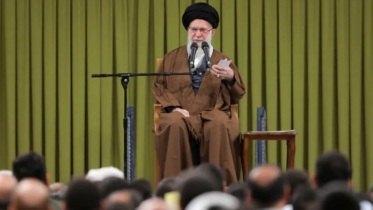
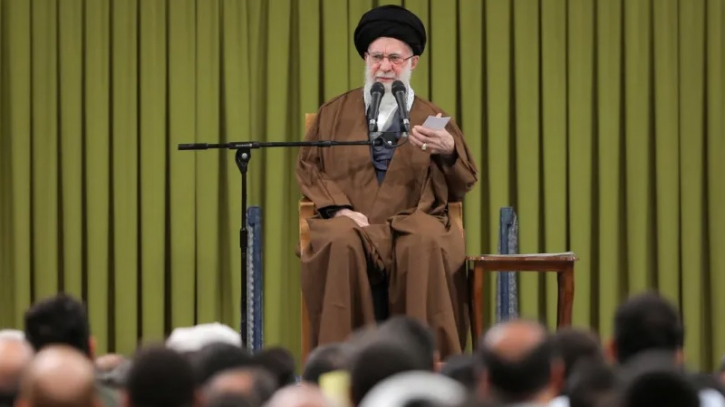
Iran’s supreme religious leader Ayatollah Khamenei.
The Financial Times recently published a report titled “Descendants of Iran’s revolutionaries call for reconciliation with the world.” It highlights a growing trend among Iran’s new generation of political elites, many of whom are children of the Islamic Republic’s founding fathers, who say Iran needs to fundamentally restructure its foreign policy.
One of these voices is Hamzeh Safavi, the son of a former commander of the country’s Revolutionary Guard Corps (IRGC) and a senior adviser to the Supreme Leader. In his view, Iran must decide whether Tehran will “challenge or support” the regional and global order. At the heart of this restructuring is a desire to moderate long-standing ideological positions, particularly Iran’s laxity on the Israeli-Palestinian issue.
Safavi and his fellow thinkers argue that Iran can demonstrate its willingness to work within an internationally recognized framework by supporting the Saudi-backed Arab peace initiative and the two-state solution. This, they argue, would dispel the perception that Iran seeks to undermine the international system.
It would also reduce regional tensions, reduce security risks, and ease economic recovery by reducing geopolitical risks. In this view, ideological restraint is seen as a tool for strategic normalization. The report examines and evaluates the proposals. It does not question the sincerity of these voices, nor does it deny Iran’s deep economic crisis or the need to avoid major future conflicts.
Rather, it argues that the proposed policy is unlikely to abandon Iran’s long-standing one-state position on the Palestinian issue in favor of a two-state solution. This is because it could increase Iran’s strategic vulnerability, alienate existing allies, and weaken its regional position without receiving equal benefits from its adversaries.
While the classical theories of international relations—realism, liberalism, and constructivism—provide important perspectives, none of them alone is sufficient. The minimum that is needed is a coherent causal chain, i.e., a relationship between all the challenges and possibilities. For example, the current structural reality (power distribution, threat environment, alliance structure); the proposed policy change (the means); the expected outcome (the goal); a credible process for reaching the goal from the means and historical or evidence-based precedents that show that process has worked in comparable situations. Without this chain, policy advice is just wishful thinking.
In this case, the proposed chain is a policy change that would see Iran support a two-state solution and soften its ideological stance toward Israel. This would reduce Iran’s recalcitrant image, reassure regional parties, and send a signal of restraint to the West. The result would be improved regional security, economic relief, and diplomatic normalization, especially with the United States. The pragmatic position can be reconstructed from the Financial Times interviews as follows.
First, the economic crisis exacerbated by sanctions, capital flight, corruption and the risk of war needs to be addressed. The ideological conflict, especially on the Israel-Palestine issue, is seen as an unnecessary burden. Second, Iran’s strong stance in favor of a referendum on a one-state solution, while moral, places it outside the internationally recognized framework. By supporting a two-state solution, Iran can reposition itself as a ‘responsible’ regional actor rather than a ‘spoiler’.
Third, it would reduce the hostility of the Gulf Arab states, create opportunities for regional dialogue, reduce the perception of the Israeli threat, facilitate negotiations with the United States and ultimately open up economic opportunities through the easing of sanctions.
These arguments are compelling. Throughout history, many states have softened their ideological positions for economic and security reasons. China is often cited as an example. It has prioritized economic development, working within international institutions, while being a regressive force. The Arab states that normalized relations with Israel through the Abraham Accords also seem to have gained initial strategic benefits. However, the comparison is only valid when the structural conditions are comparable. But the argument that Iran’s policy change can bring benefits is not realistic.
Post-Assad Syria
The most immediate evidence-based counterexample is post-Assad Syria. After the fall of the Assad regime, Damascus adopted a much less confrontational stance toward Israel and signaled a compromise and de-escalation. If the pragmatic argument were correct, Israeli pressure should have eased, sovereignty should have improved, and regional support should have increased, but the opposite has happened.
Israel has increased its military presence in Syria by seizing more territory beyond the Golan Heights. Israeli attacks have not decreased, but have increased. Despite positive rhetoric in the Western media, the new central government has proven to be weaker than the Assad government in preventing foreign infiltration.
According to The Economist, Syria's economy is now worse off than it was in Assad's final years, and its ability to defend its sovereignty has been severely eroded. Most importantly, no meaningful regional coalition has emerged to defend Syria. Neither the Arab states nor Turkey have stepped up to block Israeli moves.
This means that concessions are
.png "Advertisement")