.png)
Iran and Israel are preparing for war in parallel
Published : 06:25 PM, 14 December 2025
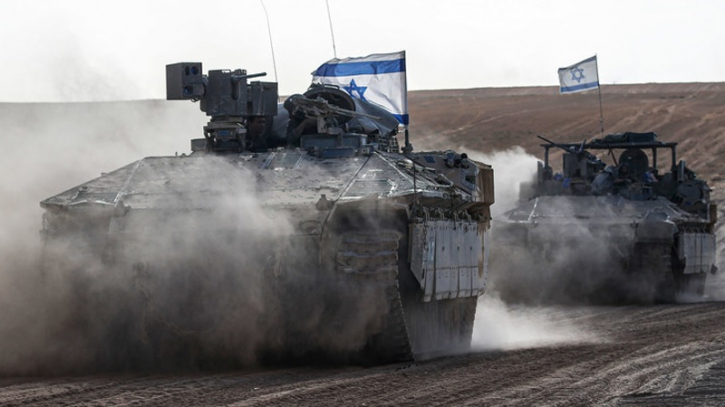
A tank carrying the Israeli flag.
At a recent closed-door meeting of the Israeli parliamentary committee on foreign affairs and defense, top officials of the country's defense force (IDF) gave a detailed briefing on preparations for a possible new conflict with Iran. According to Israeli media reports, an army representative told lawmakers that Iran has significantly increased its production of ballistic missiles and is trying to completely reorganize and expand its strike capabilities. The IDF fears that Iran could launch hundreds of ballistic missiles at once and launch a massive attack on Israeli territory, similar to the 12-day conflict.
For the past month, major Western media outlets have been making increasingly dire predictions about the Israel-Iran conflict. The New York Times, citing US officials and independent analysts, wrote that it is becoming increasingly difficult to avoid a direct military conflict between the two countries. According to the media, both sides are rapidly building up their military capabilities, expanding proxy fronts and moving further away from effective diplomatic channels. As a result, the risk of a new war is constantly increasing.
The media also added to the current tensions the expiration of the 2015 nuclear agreement (JCPOA), which expired in October this year. The collapse of the agreement imposed new tough sanctions on Tehran and effectively brought nuclear talks to a standstill.
The New York Times also reported that despite Tehran’s claims that all of its highly enriched uranium stockpiles have been destroyed, Israeli officials still believe that Tehran has secretly moved some of it to a safe place.
Concerns are also growing among the Gulf states. The countries believe that another Israeli attack on Iran is not a question of ‘if’ but ‘when’. In Israel’s view, Iran’s nuclear program is an existential threat. As a result, the option of military action is no longer a fantasy, but almost inevitable.
Meanwhile, Ali Vaez, director of the Iran project at the International Crisis Group, said that his Iranian sources tell us that Iran’s missile factories are operating 24 hours a day and that there is a plan to launch 2,000 missiles at once to destroy Israeli defenses in the event of a new conflict. Earlier, Tehran launched 500 missiles in the 12-day war last June.
Experts say that the root causes of the Iran-Israel conflict are still unresolved, creating a cycle of conflict. The 12-day war in June and especially the regime change in Syria last year have dealt a major blow to Iran’s long-standing “axis of resistance.” Yet Tehran still has important regional resources at its disposal. Such as Ansarullah (Houthi) in Yemen, Hezbollah in Lebanon and various Shiite militias in Iraq. Through these forces, Tehran still maintains a kind of asymmetric deterrence.
Israeli media reported that a top source in the country's security services claimed that Israel is considering the possibility of a regime change in Iran before the end of Donald Trump's second term, that is, before January 2029. The source said that while Iran is increasing its missile arsenal, Tel Aviv is constantly monitoring Iran's nuclear and defense facilities. As a result, experts believe that another military conflict is now only a matter of time.
The New York Times says that Iran is building a new underground uranium facility known as 'Pickaxe Mountain' south of Natanz. Where inspectors from the United Nations Atomic Energy Agency (IAEA) have not yet been allowed to enter.
In this context, Iranian President Masoud Pezeshkian said that Tehran wants peace and dialogue, but will not bow to pressure, nor will it abandon its nuclear and missile programs. According to him, these programs are inextricably linked to national sovereignty. He expressed interest in returning to multilateral talks, but stipulated that Iran's scientific, technological and defense capabilities must be preserved.
US President Trump, acknowledging that the US was involved in the Israeli attack on Iran in June, also said that Washington is ready to ease sanctions on Tehran if it wants. Within hours of Trump's statement, he met with Saudi Crown Prince Mohammed bin Salman in Washington. There, Trump again said that Iran wants a deal with the US and Washington is ready to talk.
On the same day, Kamal Kharazi, an advisor to Iranian Supreme Leader Ayatollah Ali Khamenei, said that Iran is ready to talk with the US on the basis of mutual respect and equality, but Washington must take the first step. He made it clear, however, that the ballistic-missile program cannot be discussed. He called it a key pillar of national resistance.
Analysts believe that Trump does not want the US to engage in a direct war with Iran. But Israel sees this situation as a historic opportunity. Israel wants to use this opportunity to permanently destroy Iran's nuclear and missile capabilities. And so Tehran is not counting on optimistic talk. Iranian diplomats believe that Israel is moving forward with military plans regardless of regional reactions or US objections. According to them, if Israel attacks, it will try to drag the US into the conflict in any way.
As a result, as Israel moves forward with strategic assertiveness, Washington will be drawn into the conflict whether it wants to or not.
.png "Advertisement")