.png)
Truman to Trump: Have US Presidents Bowed to the Israel Lobby?
Published: 05:32 PM, 3 August 2026
A new study has sparked a debate about US Middle East policy, claiming that almost every US president from President Harry S. Truman in 1948 to current President Donald Trump has bowed to political pressure from the pro-Israel lobby at some point.
According to the authors, this has led to domestic political pressure influencing US foreign policy more than the US’s declared national interests.
The analysis states that during the 1948 Palestine War, Truman faced a difficult decision. On the one hand, Zionist organizations and domestic political advisors were pressing for recognition of the Jewish state. On the other hand, top military and diplomatic officials, including Secretary of State George C. Marshall, warned that such a decision would create a long-term conflict in the Middle East and damage US relations with the Arab and Muslim worlds.
Marshall directly warned Truman at the meeting that recognizing Israel for political gain would undermine the president's prestige. Although Truman agreed with him at the meeting, he ordered Israel to be recognized within just two days, considering the electoral reality.
According to the authors, this was a pattern that was repeated repeatedly in US foreign policy in the following decades.
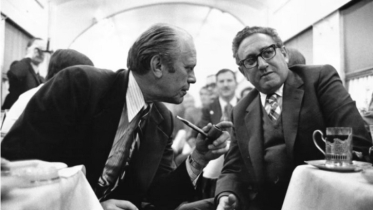
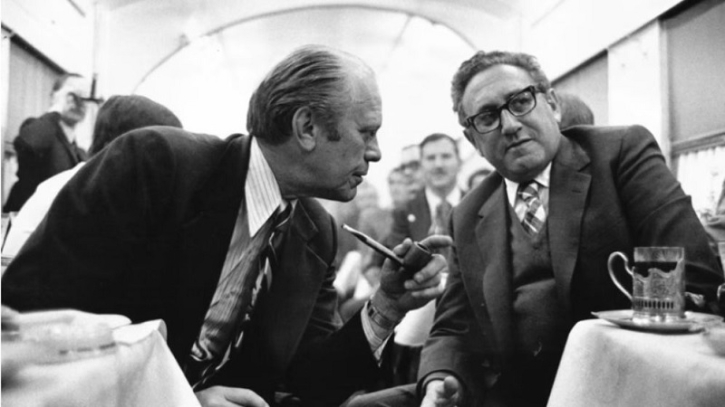
The analysis also states that in the 1970s, President Gerald Ford and Secretary of State Henry Kissinger took the initiative to reevaluate Middle East policy. Kissinger's 'Wise Men' committee unanimously recommended that Israel be pressured to withdraw from the West Bank and Gaza in the interests of an Arab-Israeli peace agreement.
However, after this recommendation was made public, the American-Israel Public Affairs Committee and other pro-Israel organizations began a massive campaign. Political pressure was exerted on President Ford through a letter signed by 76 senators. He ultimately rejected the recommendation and increased US military, economic and diplomatic support for Israel.
President Jimmy Carter faced a similar situation. He advocated the establishment of a ‘Palestinian homeland’ as part of a lasting peace in the Middle East. But his efforts were ultimately limited by strong opposition from the pro-Israel lobby and fears of political damage. Later, although a separate peace treaty was signed between Israel and Egypt, the Palestinian issue remained outside the main discussion.
The analysis states that President George H. W. Bush also faced intense lobbying to create financial pressure for Israeli settlement construction in the occupied territories. At the time, he publicly commented that there were about 1,000 lobbyists working against him on Capitol Hill, while he had only one official for him.
According to the authors, Barack Obama, after taking office, took the initiative to implement a two-state solution, but could not continue the pressure to stop Israeli settlement construction. He eventually changed his position in the face of opposition from the Israeli government and influential US lobbies. Later, his statements at the UN also showed more support for Israel than before.
The analysis noted that a similar trend was observed in the case of Joe Biden. Several recommendations of his top advisers were ignored during Israel's military operation in Gaza after the October 7, 2023 attack. Although he expressed limited concern about civilian casualties, overall US support for Israel continued.
The authors claim that there has been a significant change in public opinion around Israel in the United States after the massacre in Gaza. According to them, many American citizens have reacted strongly against Israel's military operations in Gaza, Lebanon and the West Bank. This has also had a political impact on the Democratic Party. Nearly a third of voters who voted for Joe Biden in 2020 but did not vote for Kamala Harris in 2024 said that ending Israel's violence in Gaza was the most important factor in their voting decision.
The authors claim that support for Israel has declined in both major political parties in the United States. According to them, about 60 percent of Americans have a negative view of Israel, and candidates critical of Israel are doing better in congressional primaries than before.
However, despite this shift in public opinion, it is noted that the influence of the pro-Israel lobby has not diminished. According to the authors, they are active in furthering President Donald Trump's Middle East policy.
At the same time, they say that other financially powerful interest groups, such as the pro-Israel lobby, also influence policymaking in the United States. Their warning is that if dissenters are not always able to express their views freely for fear of being labeled as ‘anti-Semites’, then US policy in the Middle East will remain unbalanced in the future.
Source: The Guardian
.png "Advertisement")