.png)
Why Saudi Arabia will issue passports to millions of camels
Published: 08:29 PM, 8 February 2026
The Saudi government has decided to issue passports to millions of camels in the country. According to officials, the initiative will ensure better management of the country's valuable animals. Saudi officials say the move will make the camel farming sector more efficient and create a reliable database of camel identities and ownership.
A video posted on social media by the Saudi Ministry of Environment, Water and Agriculture also showed a picture of the document. It shows a green passport with the country's emblem and a picture of a golden camel.
According to government estimates, in 2024, Saudi Arabia had about 2.2 million camels, contributing more than 2 billion riyals to the country's economy every year. There are about 35 million camels worldwide, of which 17 million are in the Arab world. Somalia leads the Arab world in terms of camel numbers. It is followed by Sudan, Mauritania, Saudi Arabia and Yemen.
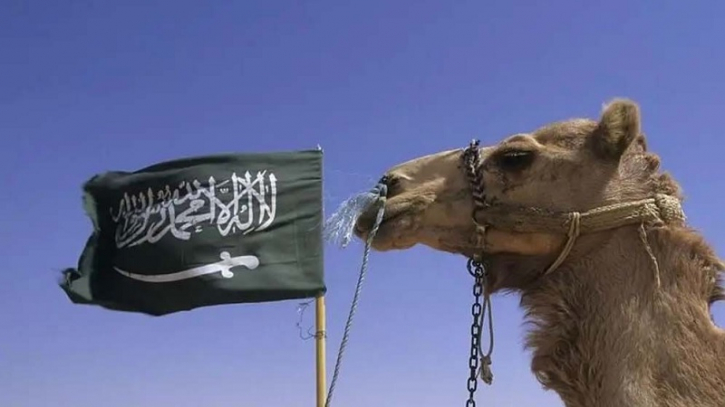
The camel is part of the national emblem of Saudi Arabia. The country also organizes beauty contests and exhibitions for this animal, where the best camels are awarded. Saudi official exhibitions on national, special and historical days are incomplete without the presence of camels.
The role of camels in Saudi Arabia and the Arab Gulf countries as a whole has a long history. Looking back in history, it can be seen that in the early 20th century, camels were the only means of transportation to the holy cities of Islam, Mecca and Medina.
Hajj and Hajj caravans from Afghanistan, Central Asia, South Asia and even the Far East used to travel long distances to reach Saudi Arabia on camels.
The tradition of using camels for transportation in the arid deserts of the Gulf region dates back several centuries. A study has shown that stone sculptures of camels carved in Saudi Arabia may be the oldest animal paintings in the world.
When they were first excavated in 2018, researchers estimated that they were made about 2,000 years ago. This was estimated due to similarities with artifacts found in the ancient city of Petra in Jordan. However, subsequent studies determined that the age of these camel images was seven to eight thousand years old.
Determining the exact age of rock carvings is a major challenge for researchers. Because, unlike cave paintings, there is usually no organic material that can be tested. It is also rare to find such high-quality rock paintings in this region.
In September 2021, an international team of researchers published the results of their research in the journal Archaeological Science.
They determined their new age by analyzing the patterns of erosion of the sculptures, various markings, and animal bones found in the area. The antiquity of these monuments is such that they may be older than the 5,000-year-old Stone Age, or older than the Pyramids of Giza in Egypt, which are about 4,500 years old.
The monuments were built at a time when camels were not domesticated. However, later camel farming began to play an important role in the economic development of the region. When these sculptures were made, Saudi Arabia was not what it is today. Instead of the present desert, there was a vast green and grassy area, with lakes.
Why the camel sculptures were made is still unclear. However, researchers believe that they may have been used as a meeting place for nomadic tribes.
Riyadh newspaper columnist and Saudi historian Dr. Badr bin Saud said that camels have been an integral part of life in the Arabian Peninsula for centuries. He said, “Without camels, it would have been impossible to survive in this dry and extremely hot desert.” From this need, the role of camels in the economy, culture and various aspects of life in the Arab world developed.
According to Badr bin Saud, “In the pre-Islamic era, poets like Tarfa ibn al-Abd mentioned camels in their poems. Camels have played such an important role in human life that it cannot be ignored. That is why the Prophet of Islam (PBUH) also had a camel, whose name was Kaswa.
Although the need for camels in transportation has now decreased to a great extent, the love and historical relationship between camels and Arab leaders still remains strong. King Abdulaziz, the founder of modern Saudi Arabia, had a camel herd called 'Al-Ramaat' and a special camel, whose name was 'Al-Duwayla'. King Salman is also a big fan of camels.
Badr bin Saud said, 'Once the king requested Prince Saud bin Muhammad to send him one of his beautiful camels (Manakiyya). Saudi Crown Prince Mohammed bin Salman also has a beautiful and advanced breed of camel called 'Al-Sharf'."
Camels are called 'ships of the desert' because a camel can carry a load of up to 400 kilograms. Due to the lack of cars and other modern transportation, the caravans of the Quraysh leaders of Mecca used to travel to Syria and Yemen on camels.
400 years ago, traders known as 'Iqlat' traded camels as far away as India, Turkey, Morocco and Nigeria. Even a few decades ago, camels were used for oil extraction and refining. Camels are divided into different categories based on color. Camels range in color from brown to reddish.
According to camel experts, camels from Oman and Sudan are known for their running ability, while camels from the coastal regions of Saudi Arabia are known for their high milk production.
The huge investment that Saudi Arabia is now making to survive in the competition with the world's technology-dependent and modern era is part of that competition. As such, the country is trying to incorporate the historical value and cultural characteristics of the camel.
Currently, an organization called 'Swani' is producing camel milk and milk products.
.png "Advertisement")