.png)
Canada is preparing for a possible US attack
Published: 08:33 AM, 4 October 2026
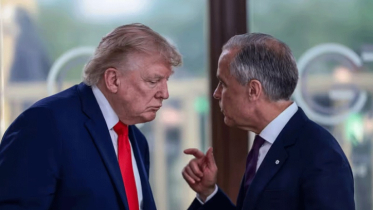
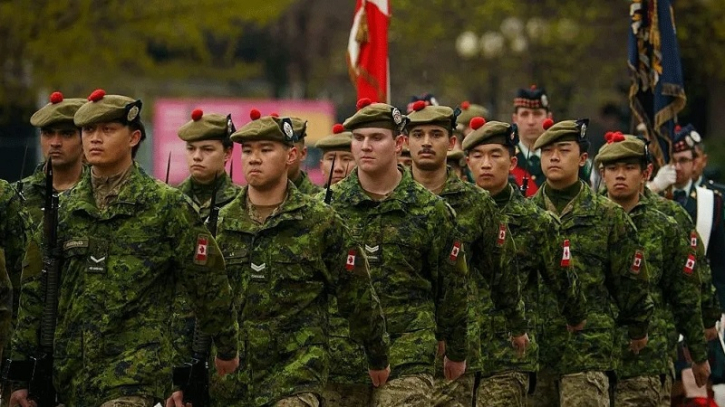
Canadian Prime Minister Mark Carney said last week that he was preparing for a situation that was once unthinkable — a US invasion.
Carney, however, believes that the likelihood of that happening is extremely low. He told the New York Times that it is his responsibility to consider all possibilities as US-Canada relations take a new turn under US President Donald Trump.
"This is just part of risk management," the Canadian prime minister said.
Canada is reviewing a potential US attack under its defense mechanism in light of Trump's global tariff policy and repeated statements of intent to make Canada the 51st state of the United States.
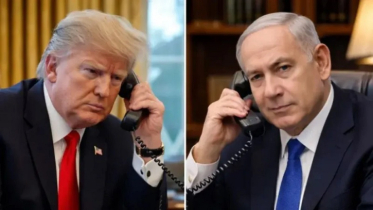
In 2025, Trump said the likelihood of the United States using force against Canada was "extremely slim." Instead, he said he would continue to use economic pressure to achieve political goals.
The White House recently said in a statement that President Trump has done more than anyone else to protect the Canadian people.
Many military experts believe that the likelihood of such an invasion is very low, citing the existing multifaceted cooperation between the two countries in the defense sector.
However, it is clear that the issue has caused concern among Canadians.
After the United States kidnapped Venezuelan President Nicolas Maduro in January, a Ledger poll found that more than 30 percent of Canadians believe there is a risk of US invasion.
Why the chances of a US invasion are slim
Lieutenant General Christopher Coates, a former officer in the Royal Canadian Air Force, said a war between Canada and the United States would be extremely complex and difficult to imagine.
"My entire career has been involved in military operations, but we have never considered the possibility of a military attack from US soil," he said.
Coats, who serves on a NATO mission, said Canada and the United States cooperate in many areas of military defense.
Both the United States and Canada are members of NATO, which requires that if one member is attacked, another member must come to its defense.
The two countries also conduct joint defense operations in the Arctic under the North American Aerospace Defense Command and regularly exchange intelligence. That's why Coats believes that any US attack on Canada would not begin with a direct armed attack; rather, it could begin with more covert means like cyber warfare.
The relationship was not always friendly.
After World War II, in the late 20th century, Canada and the United States became natural allies and became economic, military, and cultural partners.
"But that wasn't always the case," says Tim Foran, a researcher at the Canadian War Museum. "In fact, a fundamental foundation of Canada's identity is its resistance to US expansionist policies in the 18th and 19th centuries."
Canada was formed by combining the colonies in British North America that were loyal to the British Crown when the colonies that now comprise the United States rebelled.
Before Canada emerged as a nation, the United States attempted to invade the British North American colonies; in 1775, they captured Montreal and almost captured Quebec City.
During the War of 1812, the Americans repeatedly invaded what was then Upper Canada, Lower Canada, and the coastal regions, with inconclusive results. During that war, British troops burned the White House in retaliation, a notable event in history.
Foran said that at that time, the colonies that later formed Canada relied on Great Britain and its Royal Navy for their protection, and on indigenous peoples who played the role of commanders in important battles.
In the wake of the growing power and influence of the United States after World War I, Canada once again considered war with the country.
A plan was also developed for this purpose, based on secret visits by Canadian army generals to border towns, disguised as tourists, and taking photographs of bridges and highways to gather intelligence.
They also spoke to local residents to get a better idea of the enemy.
Andrew Birch, a researcher at the Canadian War Museum and an expert on 20th-century Canada, said that while the risk of war was low at the time, Canadians wanted to be prepared for possible situations.
"That's the nature of the military. They consider a variety of situations," he said.
What a possible US invasion might look like
Although the risk of a US invasion is extremely low, Matthew Schmidt, an associate professor of national security at the University of New Haven in Connecticut, said the fact that Canadians are so prepared demonstrates how radically the world order has changed.
He added that Canadian leaders now face some tough questions — such as how closely they want to continue working with the U.S. military, which provides the United States with vital information that could be used to harm Canada.
"This is damaging relations with the United States and there is a kind of rational fear about it," he said.
He added that Americans may not have taken Trump's comments about making Canada the 51st state of the United States seriously, but Canadians have taken it seriously and are prepared to defend themselves if necessary.
So what might the situation be like if such an event occurred? The first phase of the war could be quite short.
Earlier this year, a report in the Globe and Mail newspaper cited a model used by the Canadian military that predicted that Canada's strategic positions could be overwhelmed within a week of a US attack.
Then the Canadian military would be greatly outnumbered and the Canadian forces would have to resort to guerrilla warfare tactics to repel the enemy.
The report, published in January, quoted senior government officials as saying that Canada would need to turn to allies like France and Britain for assistance and protection.
It is believed that this is the first time in a century that Canada has drawn up a plan against a possible attack by the United States.
Coates said that this model is a relatively low-intensity or early-stage plan in terms of military war planning.
He said Canada had lagged behind other NATO allies in developing a specific plan to counter a ground invasion; but in these uncertain geopolitical times, they are now trying to fill that gap.
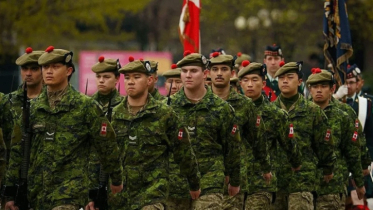
Evidence of this can be found in a recent call by Canada's defense chief, which calls for a massive increase in the size of the military—including a proposal to include up to 300,000 lightly-trained citizen-soldiers.
From the US perspective, an invasion of Canada may not be an easy task. Schmidt said that despite its massive military power, it would be difficult for the US to garner the necessary support or consent to go to war against Canada.
"I think a large number of US officials would resign if an order was given to invade Canada. They would consider it an illegal and immoral order," he said.
He also said that Canadian and US troops regularly conduct joint training and respect each other.
However, if relations deteriorate into a situation of direct conflict or war—which is highly unlikely—the United States will likely focus on seizing Canada's valuable resources, such as oil and minerals, as well as overthrowing or disabling the country's political leadership.
"Then we might see a kind of operation similar to what happened in Venezuela," he said.
Acknowledging that the US military capabilities are much greater, he said that in terms of comparative strength, Canadian troops would also be able to resist quite well.
Source: BBC
.png "Advertisement")