.png)
Germany Hit Seven, but Curaçao Create a World Cup Memory for the
Published: 05:49 PM, 15 June 2026
This is one of the great joys of the FIFA World Cup. With the tournament now expanded to 48 teams, such moments are becoming even more possible. Curaçao proved exactly that.
Many football fans around the world first heard of the Caribbean island nation when it played a friendly against Argentina in March 2023. Since then, Curaçao's profile has grown, particularly after becoming the smallest nation by population ever to qualify for a World Cup. Yet what unfolded in Houston on Sunday night ensured that the world will not forget them anytime soon.
Germany marked Curaçao's World Cup debut with a commanding 7-1 victory, but the scoreline tells only part of the story.
For the thousands of "Blue Wave" supporters inside the Houston stadium and the little more than 158,000 people back home on the tiny Caribbean island, this was a match that will be remembered for generations.
For a nation of such modest size, simply qualifying for the World Cup was a historic achievement. But scoring a goal on the grandest stage of all—against four-time world champions Germany—elevated the occasion to something unforgettable.
While Germany scored seven times, it was Curaçao defender Livano Comenencia who etched his name into the country's football folklore. His 21st-minute strike past legendary German goalkeeper Manuel Neuer became Curaçao's first-ever World Cup goal. Decades from now, whenever the nation's World Cup journey is discussed, Comenencia's name will inevitably be mentioned. It was a goal that secured a place in history.
Before kickoff, many observers had described the contest as one of the biggest mismatches in World Cup history. Germany entered the tournament ranked ninth in the FIFA rankings, while Curaçao sat 72 places lower. It was the largest ranking gap in a World Cup match since North Korea faced Ivory Coast in 2010.
Germany's potential for a high-scoring performance was never in doubt. The Germans famously defeated Saudi Arabia 8-0 at the 2002 World Cup, and Julian Nagelsmann's side looked similarly ruthless here. Their 7-1 victory sent a strong message to the rest of the tournament—Germany appear to have rediscovered their old identity.
That will not be welcome news for rival teams.
Yet Germany's dominance also served as a reminder that there is no room for mercy at the World Cup. After Curaçao equalized, the Germans responded by scoring six more goals. The scoreline inevitably reminded some fans of Germany's famous 7-1 demolition of Brazil in the 2014 World Cup semi-final.
Germany, after all, still have unfinished business at the World Cup. Since lifting the trophy in 2014, they suffered group-stage exits in the next two editions and failed to win their opening match in either tournament. A goal-fest seemed possible. Few, however, expected Curaçao to find the net.
That is the magic of the World Cup, where fairy tales and football storms are often born on the same night.
Germany needed only six minutes to open the scoring through midfielder Felix Nmecha, the fastest goal of the tournament so far. But the defining moment for Curaçao arrived 15 minutes later.
After a couple of promising attacks, Comenencia found space inside the penalty area and fired a left-footed shot beyond Neuer. The 40-year-old German captain, the oldest player ever to represent Germany at a World Cup, could not keep it out. Curaçao had their historic first goal.
The small section of blue-clad supporters inside the stadium erupted. One can only imagine the celebrations taking place across the island nation.
The goal, however, awakened a sleeping giant.
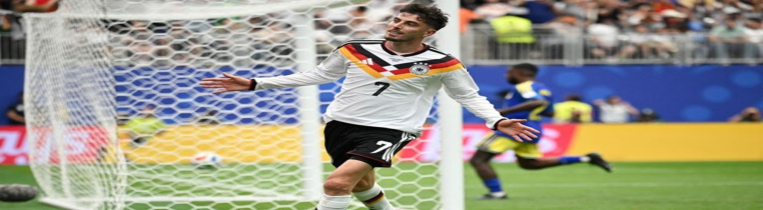
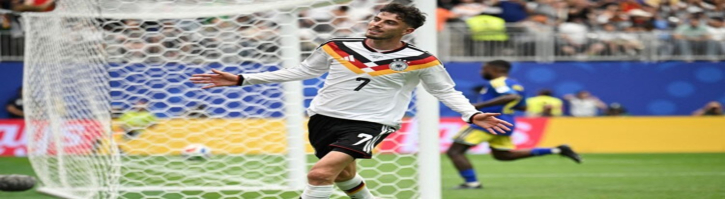
Germany restored control before halftime, moving 3-1 ahead through Nico Schlotterbeck and a penalty from Kai Havertz. The second half brought four more goals. Jamal Musiala started the scoring after the break in the 47th minute, while Nathaniel Brown, Deniz Undav, and Havertz added their names to the scoresheet before the final whistle.
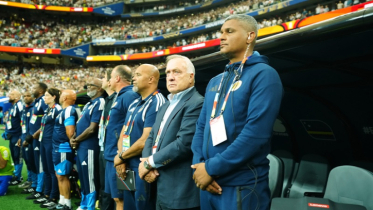
The match also produced a World Cup coaching record. Curaçao boss Dick Advocaat, aged 78, is the oldest coach at the tournament, while Germany's Julian Nagelsmann, 38, is the youngest. The 40-year age gap between the two is the largest ever between opposing coaches in a World Cup match.
Yet when the final whistle blew, those differences seemed irrelevant.
Players from both teams gathered together on the pitch, sharing smiles and conversations. In that moment, the World Cup's deeper message of unity was on display.
Historically, this was the fourth 7-1 scoreline in World Cup history. Germany have now been responsible for two of them. The others were Italy's 7-1 victory over the United States in 1934 and Brazil's 7-1 win over Sweden in 1950.
Curaçao also joined an exclusive list. They became only the third nation to score their first-ever World Cup goal against Germany in their tournament debut, following Morocco in 1970 and Algeria in 1982.
But for Curaçao, the records and the seven goals conceded hardly matter.
For a nation experiencing its first World Cup, football's biggest stage is a celebration. And what better way to celebrate than by scoring a historic goal in your very first appearance?
That memory, more than the result itself, will live forever.
MMR
.png "Advertisement")