.png)
It marked the first time in World Cup history that two countries
Published: 10:50 PM, 11 June 2026
That pattern was first broken in the 2002 edition. It marked the first time in World Cup history that two countries—Japan and South Korea—co-hosted the tournament. Yet even then, the opening ceremony tradition remained unchanged. It was held only in Seoul.
Now, however, not only has the number of host countries increased, but the tradition of a single opening ceremony has also been dismantled.
For the first time in the tournament’s 96-year history, the World Cup is being hosted by three countries—the United States, Mexico, and Canada. And for the first time ever, opening ceremonies will be held in all three countries: Mexico City, Toronto, and Los Angeles. The world will be illuminated by a tri-city celebration—but not at the same time.
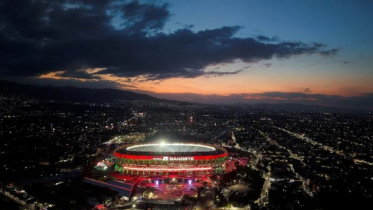
At the historic Azteca Stadium in Mexico City, the “City of Palaces,” the first match of the World Cup will take place at 1 a.m. Bangladesh time today, with the hosts facing South Africa. As in the 2010 World Cup, the opening ceremony will begin 90 minutes before kickoff. This year’s first opening ceremony starts at 11 p.m. Bangladesh time.
In Canada, the opening ceremony will take place tomorrow night. At Toronto Stadium, Canada will face Bosnia and Herzegovina at 1 a.m. Bangladesh time. That match will officially launch Canada’s World Cup campaign, preceded by an opening ceremony starting at 11:30 p.m. Bangladesh time.
In the United States, fans will have to stay up late into the night or wake up before dawn to catch the opening ceremony. On Saturday, at 7 a.m. Bangladesh time, the United States will face Paraguay at the Los Angeles Stadium. The opening ceremony there will begin at 5:30 a.m.
The Azteca Stadium in Mexico has been renovated for the World Cup.
World Cup opening ceremonies did not always generate much global excitement two decades ago. Interest grew significantly after Shakira’s unforgettable performance of “Waka Waka” at the 2010 World Cup. That performance set a new standard for opening ceremonies. Although the 1994 World Cup in the United States featured a memorable penalty kick by late legendary singer Diana Ross, it was Shakira’s electrifying presence 16 years ago that left a lasting cultural imprint.
For football fans still nostalgic about that moment, there is good news—Shakira is returning this time as well. More on that later.
Although the opening ceremonies are being held in three different cities, the concept remains unified. The goal is to showcase the culture of all three host nations.
In Mexico City, the ceremony will highlight Mexican heritage through indigenous performances, folk art presentations, and traditional “papel picado” paper craft displays. This year’s official World Cup song, “Dai Dai (Let’s Go),” will be performed by Shakira alongside Nigerian singer Burna Boy.
Artists featured on the official World Cup album are also expected to perform at the ceremony, including Alejandro Fernández, Belinda, Danny Ocean, J Balvin, Lila Downs, Los Ángeles Azules, and Maná. South African singer-songwriter Tyla will also participate in the Mexico City event. Preparations have already been completed, and the Mexican government has declared a public holiday on the opening day, along with school closures and instructions for government employees to work from home, according to President Claudia Sheinbaum.
The Mexico City opening ceremony is expected to last around 16 to 17 minutes, while the Toronto and Los Angeles segments may last approximately 13 minutes each.
In Toronto, the ceremony will begin with a countdown highlighting Canada’s proud historical moments. Performers include Alanis Morissette, Alessia Cara, Eliana, Michael Bublé, Nora Fatehi, Sanjaya (of Bangladeshi origin), VEDO, and William Prince.
The Los Angeles Stadium ceremony will feature large-scale visual storytelling and spectacular production design. Global stars including Katy Perry, Future, Anitta, Lisa, Rema, and Tyler are set to perform.
The ceremonies are being produced by Marco Balich, known for his work on several Olympic opening ceremonies. While each city will present its own unique cultural identity and atmosphere, all three events are united by a single central idea: football’s unmatched power to connect humanity and bring people together beyond differences.
MMR
.png "Advertisement")