How a famous dynasty fell for a comb
Published: 09:52 AM, 25 November 2026
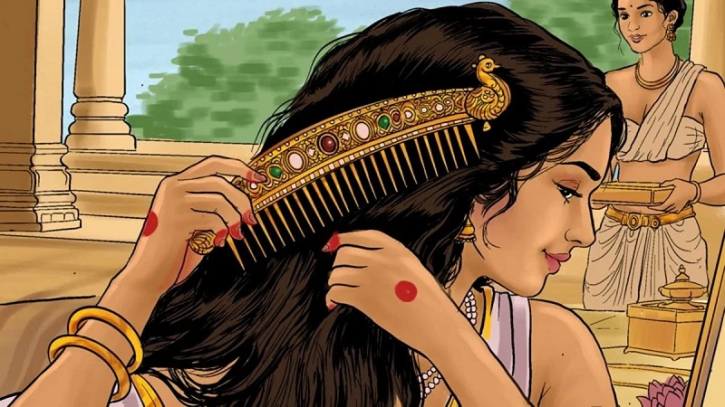
A jeweled comb. The princess demands it. And in the process of fulfilling that demand, a wealthy man's family is subjected to horrific torture.
To avenge the insult, the man took a step that resulted in the destruction of a prosperous city in western India, ending a powerful dynasty that had ruled for centuries.
The incident took place in the ancient city of Vallabhbhaipur in Gujarat. Once a center of wealth, education, trade, and culture, there is a fascinating story in history surrounding the fall of the city. And at the center of that story is a comb.
Although the history of Gujarat dates back to the Mauryan period, the most important chapter of its extensive and evidence-based history begins with Vallabhbhaipur. After the fall of the Gupta Empire, the Maitraka dynasty was established in the region in 470 AD. They ruled over a vast area of Gujarat for about 318 years, i.e. until 788 AD.
Dr. Hariprasad Gangadhar Shastri has mentioned in his book 'History of Gujarat - Ancient Era' that the reign of the Maitrakas was the second longest in the ancient history of Gujarat. The founder of this dynasty was Senapati Bhattarakka. Under his leadership, an independent kingdom emerged in Gujarat.
However, not all the historical information about how a general became the founder of an independent kingdom is available. There are various accounts in various historical texts about the rise of the Maitrakas, the prosperity of Vallabhi, and the eventual fall of the dynasty. Among these, the traditional story centered around Chiruni is particularly discussed.
Rise of the Maitreya Dynasty
According to Dr. Hariprasad Gangadhar Shastri, after the death of Emperor Skandagupta, the power of the Gupta Empire began to weaken. The distant provinces tried to gain independence one by one. Taking advantage of this situation, the general Bhattarakkara established his own independent state in Vallabhi.
Rasiklal Chho. Parikh, author of 'Political and Cultural History of Gujarat: Volume 3, Maitraka and Post-Maitrak Era', writes that there is no detailed information about how Bhattarakkara came to power. However, his Prasad mentions that he achieved fame by facing multiple attacks against powerful enemies. This suggests that he had to struggle hard against the rulers of the time to establish power.
Bhattarakkara is mentioned as a general. Therefore, historians believe that before becoming an independent ruler, he was a general of some state. He was probably also in charge of the Saurashtra province of the Gupta Empire. Later, he established his own rule centered around Vallabhipur in Saurashtra.
His domain was not limited to Saurashtra. He also controlled a large area of Kutch, North Gujarat and Central Gujarat. Later, the rulers of the Maitraka dynasty established their authority in the western Malabar region as well.
Several famous rulers emerged in this dynasty, from Bhattarakkara to Shiladitya. During their reigns, the fame of Vallabhi spread beyond the borders of the country and even abroad.
According to Dr. Shastri, Gujarat during the Maitraka and post-Maitrak periods may not have reached the peak of prosperity as it did during the later Solanki era. However, the establishment of independent rule by local dynasties by ending external rule was a major achievement.
Rasiklal Chho. Parikh also mentions the rise of the Maitrakas as an important event in the political history of Gujarat. According to him, the Maitrakas, freed from the control of external powers, established an independent system of governance. Later, their authority extended to Saurashtra, Kutch, north and central Gujarat and western Malwa. This rule lasted for several centuries.
The Maitreya rulers not only established military and political power, but also developed a well-organized administration. They patronized the development of religion, education, literature, art, trade and entrepreneurship. As a result, the economic and cultural life of Gujarat also flourished significantly during their rule.
Vallabhi, the heart of commerce and education
Vallabhipur was the capital of the Maitraka dynasty. After Girinagar, this city became one of the major political centers of Gujarat. It was renowned not only for its administrative importance but also for its economic prosperity, trade and education.
The Chinese traveler Hiuen Tsang visited Vallabhbhaipur in 640 AD. His travelogue provides detailed descriptions of the city's size, population, wealth, and social life.
The author of the book 'History of Saurashtra', Shambhuprasad Desai, quoting Hiuen Tsang, writes that the boundary of the Vallabhi state was 6,000 li, which is about 1,200 miles. The capital was about six miles in extent. The nature of the land, climate, water conditions and the way of life of the people were similar to the Malabar region.
The city had a large population. Most of the families there were wealthy. Hundreds of families with assets of more than one million lived there. Various rare products brought from distant countries were also available in the city's market.
Rajnikumar Pandya, in his book 'Cultural History of Gujarat', writes that from the account of Hiuen Tsang, Vallabhi can be identified as a major trading center. There were about a hundred families of millionaires there. During the Maitreya reign, the city also became known as one of the important centers of Buddhism.
The importance of Vallabhi is also mentioned in the account of the Chinese traveler Itzing. According to him, one of the two major Buddhist universities in India was Nalanda in the east, and the other was Vallabhi in the west.
Professor Maulana Syed Abu Zafar Nadvi, in his book 'History of Gujarat - From the Arrival of the Aryans to the Muslim Invasion', quoting Hiuen Tsang, writes that Vallabhbhai had a huge population. There were numerous aristocratic families, schools, Buddhist monasteries and temples. It is estimated that the population of the city could have been several lakhs.
According to Nadvi, valuable resources were brought from distant regions and stored in Vallabhi. Diu, Khambhat, Bharuch, Seymour, Sopara and Thane were important ports in this region. The goods and resources brought through these ports contributed to the commercial prosperity of the city.
He further wrote that the wealth of Vallabhbhai has been mentioned in various accounts since the time of the Huns. Later, Arab travelers also mentioned the immense wealth and commercial importance of the city. More than a hundred millionaire families lived there.
That is, once upon a time, Vallabhi was a city that combined education, religious practices, international trade, and vast wealth. But there are various theories and legends in history about how such a prosperous city fell.
Dispute with the royal family over the comb
Professor Maulana Syed Abu Jafar Nadvi writes in his book, "It is not easy to explain how Vallabhi, which had flourished for more than two and a half centuries, fell into ruin. There are several stories in history about this."
The most talked about story among them is about a rich man named Kaku. He had huge wealth in Vallabhipur and owned many large buildings in the city.
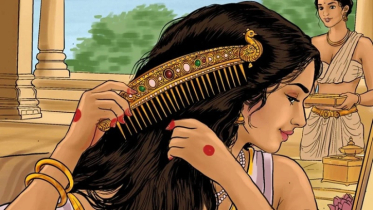
The cousin's daughter had a diamond-studded comb. One day, the princess noticed it. She liked the comb and expressed her desire to have it. But the cousin's daughter refused to give the comb to the princess.
The princess was angry. She told her father about it. The king also asked her aunt for the comb. But like the princess, the aunt also returned it to the king. The king became angry when his daughter refused to give the comb.
According to legend, the king then ordered his soldiers to rape his uncle's daughter. The uncle was humiliated by the royal family's cruel treatment and decided to take revenge.
Then, at a huge expense, he brought a foreign army to attack Vallabhi. That army attacked the city, looted it extensively, and finally defeated the king. Thus, a dispute that began over a comb ended in the destruction of a prosperous city.
However, Dr. Hariprasad Gangadhar Shastri's account of the same incident differs somewhat. He writes that the destruction of Vallabhbhai is described in detail in Jain texts. According to these folk tales, the king of Vallabhbhai, Shiladitya, snatched jeweled gold ornaments from the daughter of a highly respected woman cousin of the city and dishonored her.
To take revenge, the woman went to the Mlechcha region, where she arranged for a military campaign against Vallabhi with the money demanded by the Mlechcha leader.
Shiladitya's miraculous horse and the attack of the Arab army
Another part of the story tells of a miraculous horse of King Shiladitya. It is said that the king rode this horse into battle and won every battle. The horse had the special power to fly in the sky.
According to Jain texts, when the Mlechcha army reached Vallabhipur, King Shiladitya's miraculous horse flew into the sky by the trick of Kaku. The king was disoriented. He was eventually killed in battle and the invaders destroyed the city of Vallabhi.
According to Dr. Shastri, the incident occurred in Vikram Samvat 845, which is contemporary with the years 788-789 AD.
There is another story about Shiladitya's Surya Kund in the book 'History of Saurashtra'. It is said that during any disaster or war, the horse of the sun would come out of the Surya Kund. Shiladitya would ride that horse to go to war and return victorious.
The uncle told this secret information to the Arabs. Then they killed the cow and threw it into the tank. As a result, the horse did not come out of the tank. Instead, it flew into the sky and Shiladitya continued to roam in the desert.
According to the book, the sudden attack terrified the residents and soldiers of Vallabhipur. There is no specific information about how fierce the battle was or how long it lasted. However, the forces of the Caliph's commander Amr bin Jamal killed Shiladitya in the battle. This led to the fall of the Vallabhi Empire.
A clue to this event can also be found in the account of the Arab writer Al-Biruni. According to his account, the 'leader of the Mlechchas' mentioned in the Jain text was the ruler of Al-Mansurah. That is, he was the Arab governor of the Sindh region.
According to Jain records, the Arab army withdrew after destroying King Shiladitya and the capital Vallabhi. However, this attack also completely ended the political power of the Maitraka dynasty.
History, legend or the consequences of dictatorship?
There is no consensus among historians about the fall of Vallabhbhai. Various historical documents, including Jain scriptures, provide multiple accounts of the city's destruction. Some accounts mention a dispute with the royal family over a comb. Other accounts include stories of the theft of jeweled ornaments, the degradation of women's honor, and revenge.
It is difficult to say for sure which of these stories is completely accurate. Similarly, the historical authenticity of the miraculous horse or the Surya Kund incidents is not established.
However, various historical accounts contain a story or a similar story about Ranga Kaku. These accounts also highlight the tyrannical behavior of the last king, Shiladitya, as one of the reasons for the tragic end of the Maitreya dynasty.
Once a city of learning, wealth, and international trade, Vallabhbhai disappeared from history in a matter of centuries. And its fall is associated with the story of a jeweled comb, which is still discussed as one of the most astonishing legends in history.